19 August 2026
Granola Parfait in Dubai: The Craft Behind Every Layer
The engineering behind a parfait that holds its crunch — layering order, strained yoghurt and cluster size, explained by the people who build it.
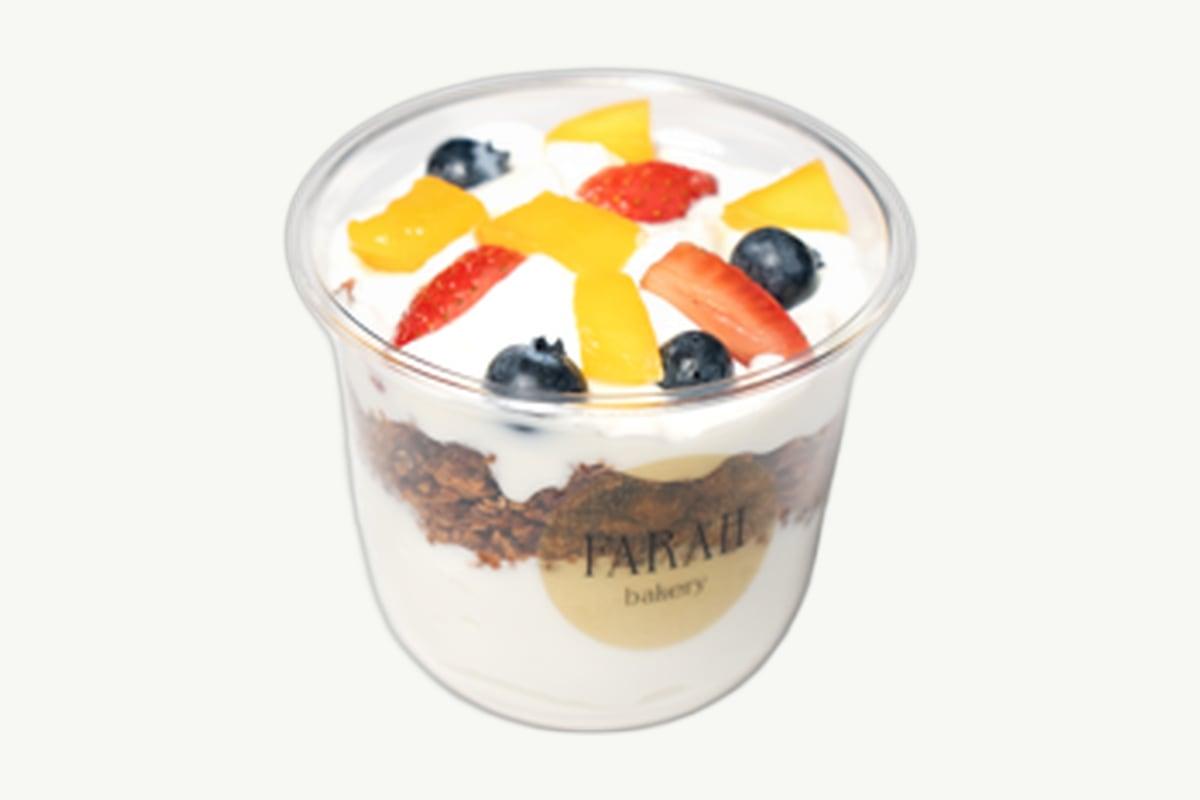
A parfait is a race against water. From the moment granola touches yoghurt, moisture starts migrating into the toasted oats, and crunch begins to leave. Everything we do when we build the Granola Parfait with Greek Yogurt — 25 AED — is about slowing that migration down: which yoghurt, which layer sits where, how big the clusters are, and how far the fruit is kept from the grain.
Why does granola go soggy in yoghurt so quickly?
Toasted granola is dry — usually somewhere in the low single digits for moisture — and it is porous. Baked oats, nuts and seeds are full of tiny capillaries left behind when the water baked out. Put that next to something wet and physics does the rest: water moves from high concentration to low, and the pores pull it in faster than gravity alone would.
The oats then do something worse than simply getting wet. Starch that was set hard and glassy during toasting softens as it takes on water, so the snap that came from a rigid, brittle structure turns into a bend. That is the moment people describe as "gone soft". It is not spoilage. It is starch rehydrating and a sugar-and-honey glaze losing its brittleness.
Two things govern how fast it happens: how much free water is available at the contact surface, and how much surface there is. Both are things a baker can control.
Why Greek yoghurt rather than regular yoghurt?
Greek yoghurt is strained. After fermentation, a large part of the whey — the thin, watery fraction — is removed, which concentrates the protein and leaves a much denser gel behind. Regular set yoghurt still holds all of that whey, loosely trapped in a fragile protein network that breaks the moment you spoon it. Anyone who has left a pot of plain yoghurt in the fridge knows the pool of liquid that appears on top. That pool is exactly what destroys granola.
Strained yoghurt has far less of it, and what remains is held more tightly by the protein matrix. The result is a layer that behaves almost like a soft cheese: it sits where you put it, it does not slump into the granola below, and it releases moisture slowly rather than all at once.
Thickness matters for structure too. A firmer yoghurt holds a clean horizontal line, so the layers stay separate on the way to your door instead of turning into a single beige mixture. And because straining concentrates protein, a Greek-yoghurt base tends to feel more substantial than the same volume of runny yoghurt — which may suit anyone who wants breakfast to actually hold until lunch. Its gentle tartness also balances the honey in the granola, so the whole cup does not read as dessert.
How layering order buys you time
Build a parfait carelessly and the granola ends up pressed against the wettest thing in the cup. Build it deliberately and anything wet has to cross something slow before it reaches the grain.
Ours starts with thick Greek yoghurt at the base, which anchors the cup. The granola goes in as a band above it, and a second layer of yoghurt covers the granola. The fruit — strawberries, blueberries and mango — sits on top, never directly against the grain, because fruit is by far the wettest thing in the cup. Cut fruit weeps continuously as its cell walls give way, and a band of dense, strained yoghurt between the fruit and the granola means that juice has to cross a thick protein gel before it reaches anything crunchy. That gel is very slow to let water pass.
There is an honest trade-off. Granola held between two layers of yoghurt meets moisture on both faces, so it softens sooner than granola scattered loose on top would. What the band buys is a parfait that holds its shape, keeps fruit juice off the oats, and survives being carried to your door. It is also the reason a parfait is a food to eat soon rather than keep.
If you build one at home, leave a little headspace under the lid. A cup filled to the brim presses the fruit down into the yoghurt and pushes its juice towards the grain.
Cluster size, and why big pieces stay crunchy longer
A cluster is not just a nicer-looking piece of granola. It is a smaller surface-area-to-volume ratio.
Loose, sandy granola presents an enormous amount of surface for its weight, so it wets almost instantly and uniformly. A proper cluster — the sort that forms when the mix is pressed while it bakes and left undisturbed to cool — wets from the outside in. The shell may soften while the middle is still glassy and audible, which is why a big cluster can still crack between your teeth long after loose oats have surrendered.
Getting those clusters takes patience rather than cleverness. Oats, seeds and nuts are bound with a syrup that sets on cooling, pressed into a slab, and baked low — around 150C — for long enough to drive off moisture without scorching the honey. Baking hot and fast browns the outside before the middle is dry, and granola that is not fully dry never gets properly hard. Then it cools completely, untouched, on the tray. Break it while it is warm and you get gravel; break it cold and you get clusters. Our guide to how granola clusters form goes through the bake step by step. The same slab-and-set principle holds a Granola Bar together in a form that survives a handbag, and our granola bar guide explains what decides whether a bar chews or snaps.
How long do you actually have before a parfait goes soft?
Honestly: less than most people assume, and rather more than the panic suggests.
With a thick strained yoghurt and decent clusters, the granola band keeps real bite for a while after the parfait is built, then softens from the outside of each cluster inwards. For a good stretch after that it is still pleasant — softened at the edges, with some bite in the middle. Leave it much longer and you are eating something closer to a very good bircher: not unpleasant, but a different dish.
Dubai makes all of this faster. Heat speeds up moisture movement, and a parked car in August is brutal on both texture and dairy. Humidity works from the other direction: coastal air can sit high, and exposed granola pulls water straight out of the air even before it meets the yoghurt. So treat a parfait as a now food. Choose a delivery window when someone will be there to receive it, put it in the fridge as soon as it arrives, and eat it soon. Our delivery page covers the practicalities, including why fresh items left unrefrigerated cannot be replaced.
How to serve a granola parfait properly
Take it out of the fridge about five minutes before eating. Straight from cold, the yoghurt's tartness and the honey's aroma are both muted; a few minutes on the counter brings them back without softening anything.
Use a long spoon and go straight down through all the layers rather than eating them one at a time. The point of a parfait is the contrast in a single mouthful — cold, dense, slightly sour yoghurt against toasted grain and cold fruit.
If you are eating it later than intended and the granola has already softened, do not try to rescue it. Instead, add fresh crunch: a spoonful of granola or a crumbled granola bar over the top restores the texture contrast immediately. And do not freeze a parfait. Freezing bursts the yoghurt's protein network, and it thaws grainy and weeping — the exact opposite of what straining achieved.
For a bigger breakfast, a parfait alongside a slice of toasted Multi-Seed Sourdough Loaf — 28 AED — gives you two very different textures from the same seeds and grains. More on how we build the rest of the morning menu sits on the blog.
Frequently Asked Questions
Can I make a granola parfait the night before?
You can, but keep the granola separate. Layer the yoghurt and fruit in the glass, cover it, and refrigerate overnight, then add granola just before eating. Assembled in advance, the grain will have softened by morning into something closer to overnight oats — perfectly nice, but no longer crunchy.
Why is Greek yoghurt better than regular yoghurt in a parfait?
Greek yoghurt is strained to remove much of the whey, so it holds far less free water and a much denser protein structure. That means less moisture migrates into the granola, the layers keep their shape rather than slumping together, and the tartness stands up to honey and fruit instead of disappearing.
How long does a granola parfait stay crunchy after delivery?
Not long enough to save for later. The granola sits between layers of yoghurt, so it starts taking up moisture as soon as the parfait is built, and Dubai's heat speeds that up. Put it in the fridge when it arrives, give it five minutes out before eating, and eat it soon rather than store it.
Can I freeze a granola parfait?
Freezing is not recommended. Ice crystals rupture the yoghurt's protein network, and on thawing it separates into a grainy solid with a pool of watery whey. The granola then absorbs that whey immediately. A parfait is built for the same day, not the freezer.
What makes granola clusters instead of loose oats?
Clusters form when the mix is bound with syrup, pressed into a slab, baked low and slow until fully dry, then left completely undisturbed until cold. Breaking it while warm produces loose crumbs. Cooling first lets the sugars set hard so the pieces hold together and stay crunchy longer.
Order a granola parfait from Farah
Our Granola Parfait with Greek Yogurt is 25 AED, made fresh every day with Greek yoghurt, a band of crunchy granola, and strawberries, blueberries and mango on top, layered in the order described above. Keep it cold when it arrives and eat it soon. Add a Granola Bar at 12 AED if you want something for the desk drawer as well. Browse the full range in the shop and we will bring it to you across Dubai.