16 September 2026
Granola Bar Dubai: Fresh vs Packaged, Chewy vs Crunchy
Why a fresh honey-bound bar reacts to a parked car differently from a packaged one, and what decides whether a bar chews or snaps.
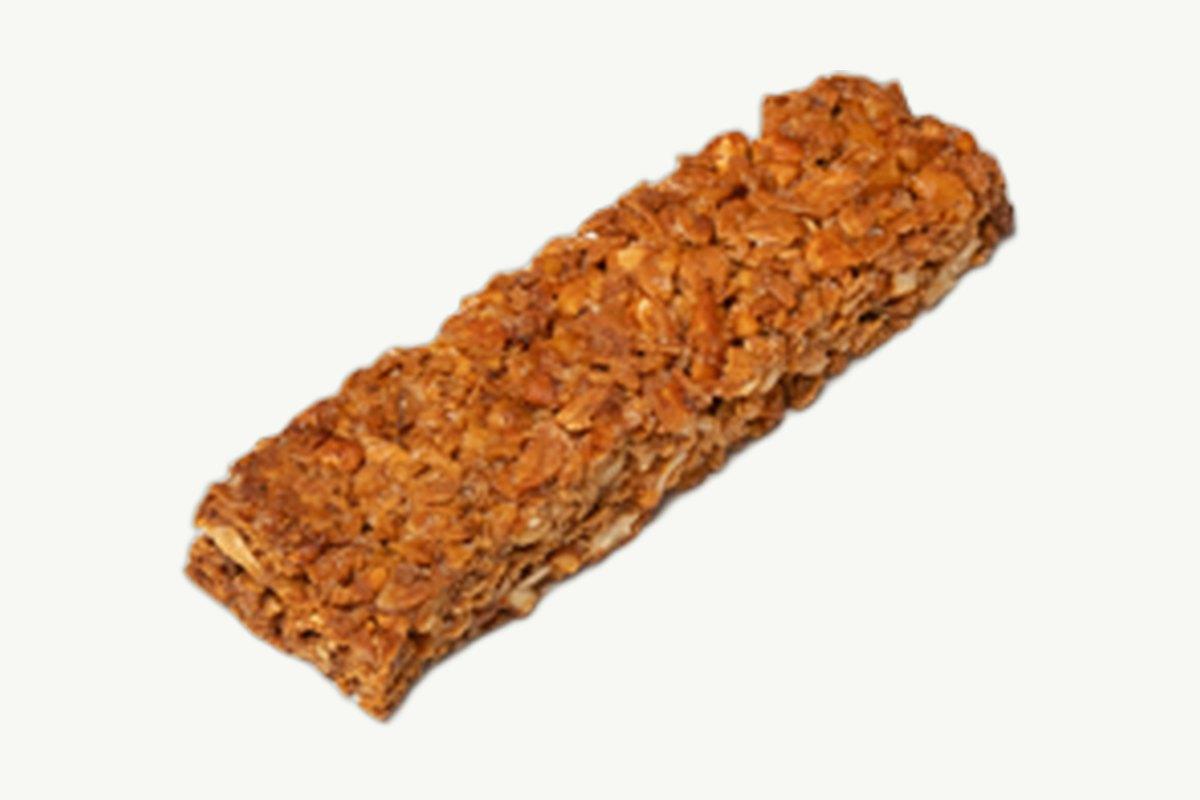
A granola bar looks like the simplest thing a bakery makes. But a bar made to be eaten fresh and a bar engineered to sit on a shelf for months are different products, and a Dubai summer shows the difference fastest.
The hard part begins once the bar leaves the kitchen. Loose granola waits in a jar and only has to stay crisp. A bar has to hold its shape in a bag, cope with the walk from an air-conditioned lobby into the heat outside, and still come apart cleanly when you bite it. How loose clusters form is covered in our granola guide; a bar asks more of the same binder, and that changes almost everything below.
Ours is toasted oats, nuts and seeds bound with honey, made fresh every day in our Dubai Silicon Oasis kitchen, and a Granola Bar is 12 AED.
Fresh and packaged bars are built for different jobs
A packaged bar has to last months at room temperature. Moulds need available water to grow, so a shelf-stable bar must keep its water low or tightly bound. Yet a bar with too little water turns hard, and a chewy one has to stay soft for months.
That tension is one reason chewy packaged bars carry long ingredient lists. Glucose syrups and humectants such as glycerol keep a bar pliable while holding its water tightly, so little is left free for moulds. Emulsifiers stop fat separating from the syrup. Antioxidants slow the oils in nuts and seeds from turning rancid, and a sealed wrapper keeps out oxygen and damp. Flavourings, sweeteners, coatings and added protein or fibre lengthen the list further.
Many chewy supermarket bars are not baked as bars at all: pre-toasted cereal is mixed with a warm syrup, pressed into a sheet, cooled and cut.
A bar made to be eaten fresh has none of those problems to solve. It is judged on how it eats soon after it is made, not after months on a shelf. The trade-off is steadiness. A packaged chewy bar is built to feel the same from edge to centre and from month to month; a fresh bar changes with the weather it meets.
Chewy or crunchy: the dials that decide it
There is rarely a separate recipe for each, just a set of dials.
Water left in the bar. A longer, drier bake drives out moisture and sets the binder hard; a shorter one leaves the bar pliable.
What the binder is made of. As a sugar syrup cools it thickens and, if little enough water remains, sets to a hard glass; which sugars are in it and how much water is left decide whether it ends up bendy or brittle — the same reason a soft caramel bends and a brittle snaps. Honey is around 17 per cent water and rich in fructose, a sugar that draws in moisture and stays soft at room temperature rather than setting to a hard glass, so honey-bound bars lean towards chew unless they are dried thoroughly.
How much binder there is. More binder per handful of oats gives a denser, chewier bar. Less gives a crisper but crumblier one, because there is less glue wherever two pieces touch.
How hard it is pressed. A tightly compacted slab gives the binder more contact points, so it holds together and eats dense and chewy. A loosely packed one is lighter and crisper, but it crumbles more easily and sheds more crumbs.
A quick test: bend a bar gently. A chewy one flexes before it gives; a crunchy one snaps with a clean edge. Try it on ours when it arrives.
Nuts and honey: what to know before you order
Our Granola Bar contains nuts and honey. Its description names toasted oats, nuts and seeds bound with honey; if you need to know exactly which nuts or seeds are in it, ask us. Honey should also not be given to babies under twelve months.
Our kitchen handles wheat, gluten, eggs, dairy, nuts, peanuts, soy, sesame and seeds, and we cannot guarantee that any item is free from traces of these; our terms set this out in full. If you or anyone you are buying for has an allergy or intolerance, ask us before you order rather than relying on the website description alone.
How a honey-bound bar behaves in Dubai heat, and how to store it
Two things drive it. Honey is hygroscopic, meaning it pulls water from the air, so a cut surface left open on a humid day turns tacky; keep a bar wrapped or sealed until you eat it. And a set sugar binder softens as it warms.
Keep it out of a parked car. A car parked in a Dubai summer gets far hotter than the air outside. In there a honey binder turns soft and tacky, a bar can sag and stick to whatever it is wrapped in, and warmth hurries nut and seed oils towards rancidity. If it travels by car, keep it in the cabin with you or in a cool bag.
Skip the fridge. Chilling sets a honey binder hard, and a cold bar unwrapped in a warm room gathers condensation. If a bar has been chilled, let it come back to room temperature still wrapped.
If heat has softened it, cool it before you judge it. Softness from warmth largely reverses as the binder sets again; softness from damp air will not come back just by cooling.
If a bar has to wait, give it the same airtight, away-from-the-oven treatment as a jar of loose granola. A fresh bar is at its best the day it arrives, so order it for when you need it, not for next week's cupboard.
Commute, school bag, desk, gym bag: when a bar makes sense
A bar answers a logistics problem: food that needs no plate or spoon.
On the commute. In a passenger seat, it is one of the tidier breakfasts to eat. On the Metro it has to wait, because eating and drinking are not allowed on the trains or in the paid areas of stations.
In a school bag. Our Granola Bar contains nuts, and some schools and nurseries do not allow them, so check the food policy first. A cool pack in an insulated lunch bag helps keep it firm on a hot day.
At the office. Set out at a team breakfast, a bar is the thing people can take back to their desk for later. Our notes on office breakfast catering cover what else holds up on a meeting table.
Before a morning class. If you would rather not arrive at a Pilates or yoga class on a full breakfast, or on nothing at all, a bar waits in a gym bag until you want it; keep it away from a sweating water bottle. If you are organising the class rather than going to it, our notes on catering around a Pilates or yoga morning cover what holds up in a studio.
A bar with a parfait, a bar with coffee
The Granola Parfait with Greek Yogurt, 25 AED, is the one to eat soon after it arrives, or to put in the fridge until you do; the bar, kept wrapped and out of the heat, can wait until later in the day. Why granola softens against yoghurt, and why thick strained yoghurt and big clusters slow it down, is in our guide to keeping a parfait crunchy.
If you have both, eat the bar alongside the parfait while the parfait is still crunchy; the yoghurt's sharpness cuts through the honey. Once the top of the parfait has softened, crumble a little of the bar over it just before eating, as that guide suggests, and the contrast in texture comes back.
With coffee, the logic is flavour. Toasting oats, nuts and seeds builds browned, nutty notes through the same browning reactions that roasting drives in coffee beans. Black coffee trims the sweetness of the honey; a milky one rounds it out.
Frequently Asked Questions
Does the Farah Granola Bar contain nuts?
Yes, and honey too: its description names toasted oats, nuts and seeds bound with honey. That description does not name the individual nuts or seeds, so ask us if that matters to you, and talk to us before ordering for anyone with an allergy.
Is a granola bar better chewy or crunchy?
Neither is better; they suit different days. A denser, chewier bar holds together in a bag and sheds fewer crumbs, which suits a commute or a school bag. A lighter, crisper bar snaps cleanly and eats more like loose granola, but it breaks more easily on the way. Honey-bound bars lean towards chew unless they are dried thoroughly, so bend yours to find out which you have.
Why do granola bars fall apart?
Usually too little binder or too little pressure. Where two pieces of oat or nut touch, the set honey or syrup is the only glue, so a lightly bound or loosely packed bar crumbles when it is cut or carried. More binder and a firmer press give a denser bar that holds together, at the cost of some crunch.
Can you leave a granola bar in a hot car?
Not a honey-bound one. A car parked in a Dubai summer gets far hotter than the air outside, so the honey binder softens, turns tacky and can sag into its wrapping. It firms again once cool, but heat also hurries the nut and seed oils towards staleness, so keep the bar in the cabin with you or in a cool bag.
Why do packaged granola bars have such long ingredient lists?
A chewy bar built to last months on a shelf has to stay soft without holding enough free water for mould to grow, and its nut and seed oils have to stay fresh. Humectants, emulsifiers and antioxidants each solve part of that problem, alongside flavourings and other additions. A bar made to be eaten fresh does not have that problem to solve.
Put a bar in tomorrow's bag
A Granola Bar is 12 AED and made fresh every day. There is no same-day delivery, so order ahead and choose a delivery window at checkout; the earliest is tomorrow morning, and our guide to fresh bread delivery sets out every window and the fee. When it arrives, keep it wrapped and out of the car, and give it the bend test before the first bite. The rest of our range is in the shop.