Lotus Cookie Dubai: Why Speculoos Must Go In as Pockets
Speculoos caramel burns before a cookie sets, so it goes in as pockets, and the white chocolate is there to stop it turning cloying.
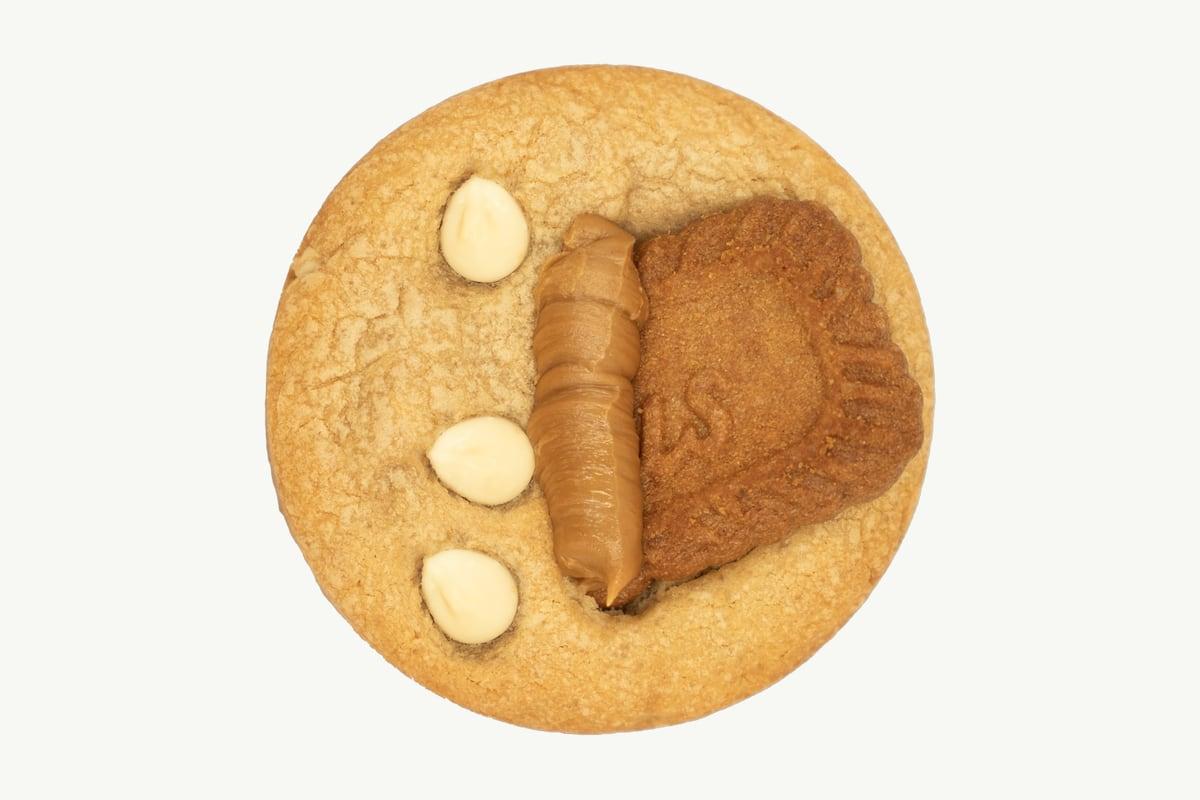
A Lotus cookie lives or dies on how the spread is handled. Speculoos spread is already a caramelised sugar syrup carrying biscuit crumb, so it browns further and then burns well before a thick cookie has finished baking. Stirred through the dough it goes bitter at the edges and greasy in the middle. Our Lotus & White Chocolate Chip Cookie keeps it in sealed pockets instead, and uses white chocolate as a counterweight, which is why it tastes considerably less sweet than the name suggests.
What speculoos spread actually is, and why the oven fights it
Speculoos is a spiced Belgian biscuit built on dark candy sugar. To make the spread, that finished biscuit is milled and emulsified with fat until it pours. Every one of those sugars has already been through a full bake. The browning is done. The caramel notes you taste are the end of a reaction, not the beginning of one.
That matters because a cooked sugar has very little headroom left. Fresh caster sugar in a cookie dough can take a long time in the oven before it darkens. Speculoos paste is already most of the way down that road, so it needs only a short push before it tips past caramel into scorch. Add the fat content of the spread and you have a mixture that softens, spreads, thins and then catches — often in under two minutes at full oven heat.
There is a texture problem too. The spread is smooth and low in water. Beat it into a butter and sugar base and it behaves like extra fat: it slackens the dough, kills structure and makes the cookie spread wide and flat. You lose the thick centre that carries the flavour.
Caramelisation and Maillard are not the same browning
Two different reactions brown a cookie, and confusing them is why so many speculoos bakes fail.
Caramelisation is sugar alone. Heat it hard enough and the molecules break apart and recombine into hundreds of new compounds — nutty, faintly bitter, deeply aromatic. Sucrose needs serious heat for this, roughly 160C and above. It is a fast, steep reaction with a short window between beautiful and burnt.
The Maillard reaction is different. It needs a sugar and an amino acid together — so, in a cookie, sugar plus the protein in flour, egg and butter solids. It starts far lower, from around 140C, and it climbs gently. It is what gives a cookie its roasted, biscuity, almost malty depth rather than pure sweetness.
A good cookie is mostly Maillard with a little caramelisation at the very edge. Speculoos spread breaks that balance because it arrives pre-caramelised, so any part of it exposed to direct oven heat starts near the top of the curve. Keep it buried and it stays a soft caramel seam. Leave it on the surface and it is charcoal.
Why the spread goes in as pockets
We portion the spread cold. It is chilled until firm, scooped, frozen solid, then wrapped inside the dough so no seam reaches the surface. The dough itself then rests in the fridge for 24 to 48 hours before baking.
That rest does three things. The flour fully hydrates, so the crumb is chewy rather than cakey. Enzymes break a little starch down into simpler sugars, which feeds the Maillard reaction and gives colour without extra sweetness. And the butter sets hard, so the cookie holds its dome for the first crucial minutes.
The bake runs around 175C for twelve to fourteen minutes — deliberately lower and longer than a plain chocolate chip cookie. Lower heat keeps the surface below the point where any speculoos that does breach the dough would scorch. Longer gives the centre time to set around the frozen pocket. The pocket itself never gets near 160C: it is insulated by dough, and the moisture in that dough holds the interior close to boiling point until the cookie is nearly done. It comes out molten, not caramelised twice.
Pull it too early and the pocket runs out the moment you break the cookie. Bake it hot and fast and the edges darken before the middle sets, which is the single most common failure with this cookie at home.
Why white chocolate, and why it is less sweet than it sounds
White chocolate is the obvious pairing and, badly used, the obvious mistake. It is cocoa butter, milk solids and sugar, with no cocoa liquor to add bitterness. Put sweet on sweet and you get a cookie nobody finishes.
Its real job here is fat and dairy, not sugar. Cocoa butter melts just below body temperature, so it coats the palate and slows how quickly the speculoos caramel hits. The milk solids bring a lactic, slightly savoury note that reads as balance. Used as chips rather than melted through, it also stays as distinct soft points against the spiced background.
To make room for it, the dough underneath is pulled back. We reduce the sugar in the base dough and lean on brown sugar for its molasses acidity, which cuts sweetness rather than adding to it. A good pinch of salt goes in — salt suppresses the perception of sweetness directly. The result is a cookie where the caramel arrives as a distinct pocket against a restrained, slightly savoury, spiced crumb. If you want the same thinking with far less sweetness, the Peanut Butter Cookie at 14 AED runs on roasted peanut flavour and salt instead.
How a Lotus cookie keeps in Dubai's heat and humidity
Dubai works against this cookie in two directions. Outdoor heat softens the pocket and the white chocolate; indoor air conditioning is dry and pulls moisture straight out of the crumb.
Keep it in an airtight container at cool room temperature, out of direct sun, and eat it within two to three days. Do not refrigerate it. A fridge is the fastest way to make a cookie stale, because cold speeds up starch retrogradation — the starch recrystallises and the crumb goes sandy while the cookie is still perfectly fresh by any other measure.
If it has been sitting in a hot car, give it twenty minutes indoors before you open the box. The pocket needs to firm up or it will run.
Reviving one that has gone firm
Three to four minutes in an oven at 150C brings it back almost completely. The heat loosens the recrystallised starch and softens the pocket without cooking the cookie further. A microwave works in a pinch — eight to ten seconds, no more — but it makes the crumb briefly soft and then tougher than before, so eat it immediately.
Everything is baked to order in our Dubai Silicon Oasis kitchen and delivered across Dubai. There is no same-day delivery, and the earliest window is the next morning. You can check areas and timings on our delivery page.
Frequently Asked Questions
Is the Lotus cookie very sweet?
Less than most people expect. The base dough is deliberately reduced in sugar and salted, and brown sugar adds a molasses acidity that cuts through. The sweetness is concentrated in the speculoos pocket rather than spread across the whole cookie, so it reads as a distinct caramel note instead of a constant one.
Why is the Lotus spread in a pocket instead of mixed into the dough?
Because speculoos is made from already-caramelised sugar and has almost no heat headroom left. Mixed through the dough it reaches the cookie's surface, browns past caramel into bitterness within minutes, and its fat content slackens the dough so the cookie spreads flat. A buried pocket stays below scorching temperature and finishes molten.
How long does it stay fresh in Dubai?
Two to three days in an airtight container at cool room temperature, away from direct sunlight. Avoid the fridge — cold accelerates starch retrogradation and makes the crumb sandy far faster than leaving it out. If the cookie firms up, three to four minutes at 150C restores it almost entirely.
Can I warm it up before serving?
Yes, and it is worth doing. Three to four minutes in a 150C oven softens the speculoos pocket and loosens the crumb. A microwave at eight to ten seconds works if you are short of time, though the cookie tightens as it cools afterwards, so serve it straight away rather than letting it sit.
How much is the Lotus cookie and what else pairs with it?
The Lotus & White Chocolate Chip Cookie is 16 AED. It sits well alongside the Peanut Butter Cookie at 14 AED, which is roasted and salted rather than sweet, so the two balance each other in a mixed box.
Order a Lotus cookie in Dubai
The Lotus & White Chocolate Chip Cookie is 16 AED, baked in small batches and best eaten the day it arrives. Our guide to choosing cookies by texture shows how it compares with the other five. Build a box on the shop page and we will bring it to you across Dubai.