Carrot Cake in Dubai: Why an Oil Cake Stays Moist Longer
Carrot cake is built on oil, not butter — which is why it stays tender for days while a sponge dries out.
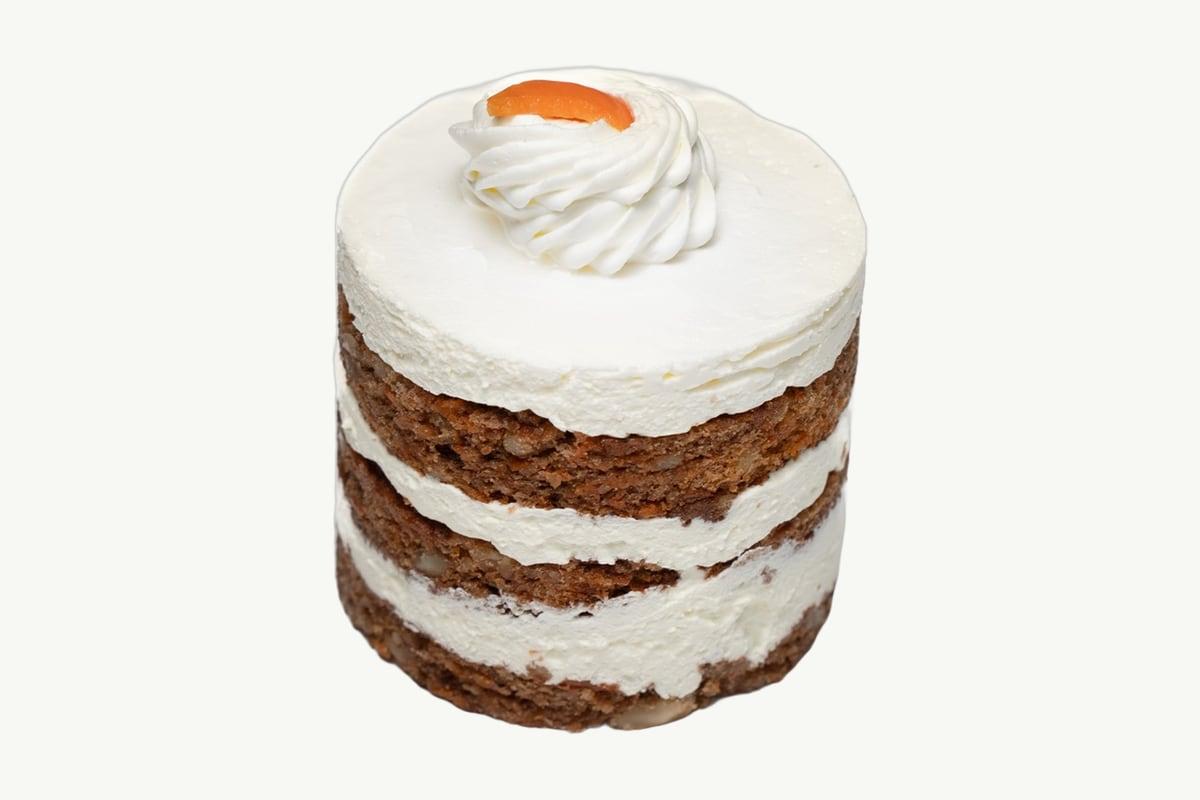
Carrot cake keeps better than almost any other cake because it is built on oil rather than butter. Butter is roughly sixteen per cent water and solid at room temperature, so a butter sponge firms up as it cools and goes dry within a day. Oil stays liquid at every temperature you will meet in Dubai, which is why a slice cut on Thursday still eats soft on Saturday.
That single structural fact explains nearly everything about the cake — the crumb, the shelf life, the way the spice deepens overnight, and the one thing you genuinely have to be careful about here, which is the frosting.
A note before you read on: carrot cake is not currently available to order online from Farah, so treat this as a baker's guide rather than a product page. The cakes we do deliver are listed at the end.
Why oil cakes stay soft and butter cakes do not
In a butter cake, you cream butter and sugar to whip air into fat crystals. Those crystals hold the structure. As the cake cools, the fat re-solidifies and the crumb tightens. Leave it on the counter and the starch begins to retrograde — the gelatinised starch molecules in the flour recrystallise and squeeze water out of the crumb. That is staling, and it is not really about moisture evaporating. It is about moisture becoming unavailable.
Oil cannot crystallise. It coats the flour proteins and starch granules in a thin liquid film that stays liquid, which does two things: it shortens gluten strands so the crumb is tender rather than chewy, and it physically slows starch retrogradation. The cake still loses some water to the air, but the crumb never seizes up.
There is a trade-off, and it is worth being honest about it. Oil carries no flavour of its own, so an oil cake has no buttery note to hide behind. Everything has to come from the spice, the sugar, and the carrot. If those are wrong, there is nothing to rescue them.
You can taste the contrast side by side. Our Classic Lemon Butter Cake Loaf is deliberately the other thing — a creamed butter loaf with a close, rich crumb, soaked with lemon syrup rather than frosted. Two cakes, two completely different design briefs.
What grated carrot actually does in the batter
Most people assume the carrot is there for flavour. It is not, mostly. Raw carrot is around eighty-eight per cent water, and in a carrot cake it functions as a moisture reservoir that releases slowly during baking rather than flashing off as steam the way free water in a batter does.
The grate size matters more than the quantity. Grate too coarsely and you get visible orange shreds that stay slightly firm and leave wet channels in the crumb. Grate too finely and the carrot collapses into pulp, dumps its water early, and you end up with a dense, almost pudding-like slab. A medium grate — fine enough to disappear, coarse enough to hold its shape through the first ten minutes in the oven — is what gives the crumb its faint, pleasant rag.
Carrot also brings sugar. Roughly five per cent of a carrot's weight is natural sugars, which is why carrot cake browns readily and why the recipe does not need as much added sugar as the colour of the crumb suggests. It also brings a slight earthiness that is the reason cinnamon works so well here — cinnamon is warm and woody and sits directly on top of that earthy note instead of fighting it.
Getting the spice balance right
Cinnamon leads. That is not negotiable, and the common mistake is treating carrot cake as a general spice cake and letting nutmeg, ginger, clove and cardamom all shout at once. The result tastes muddy and slightly medicinal.
A workable ratio is cinnamon as the clear majority, then a supporting fraction of nutmeg for depth, a smaller fraction of ginger for lift, and clove counted almost in grains. Clove is the dangerous one — it is intensely aromatic and dominates a batter at a tiny percentage, and once it is in, it cannot be pulled back out.
Spice also changes overnight. Ground spices are volatile oils held in cell fragments, and those oils need time and moisture to migrate through the crumb. On day one the cinnamon sits on the surface of the flavour. By day two it has diffused, married with the sugars, and reads as one rounded thing rather than a cake with spice added. This is the rare cake that is genuinely better the second day, and it is worth planning for.
Baking it: temperature, timing, and what goes wrong
Carrot cake wants a moderate oven, around 170 to 175°C in a conventional oven, or nearer 160°C on fan. Hotter than that and the sugar-rich, carrot-rich batter sets a crust before the centre has risen, so the middle keeps expanding, cracks the top, then sinks as it cools.
The batter itself should be mixed as little as possible once the flour goes in. Oil cakes are usually built by whisking eggs, sugar and oil to a smooth emulsion, then folding the dry ingredients through in one or two passes. Over-mixing develops gluten, and while oil suppresses that somewhat, a beaten carrot batter still comes out rubbery and tunnelled.
Three failures account for most disappointing carrot cake:
A greasy, heavy slice. The emulsion broke — usually the eggs were fridge-cold and the oil never dispersed properly. Room-temperature eggs fix it.
A wet band at the bottom. Too much carrot, or carrot grated far in advance and left to weep. Grate it just before mixing.
A dry cake despite the oil. Overbaked. Because the crumb is so moist, the usual clean-skewer test overshoots. Pull it when a few moist crumbs still cling.
Cooling matters too. Let it cool completely — an hour at least — before frosting, or the cream cheese will slacken and slide.
Why cream cheese frosting has to stay cold in Dubai
This is where Dubai genuinely changes the rules. Cream cheese frosting is an emulsion of cheese, butter and sugar, and it is stabilised almost entirely by the fat being solid. Butter starts softening around 20°C and is fully fluid by about 32°C. Full-fat cream cheese loses its structure at a similar point.
In an air-conditioned flat at 22°C, frosting is fine for an hour or two — soft, glossy, exactly right. Carried from a car to a lift in August, it is a different story. The surface goes to gloss, then to slump, and once a cream cheese frosting has broken it does not come back; re-chilling gives you a grainy, slightly separated layer.
There is also the practical food-safety point. Cream cheese is a fresh dairy product, and frosted cake should not sit out unrefrigerated for extended periods in this climate. Keep it chilled, take out what you plan to eat, and return the rest.
Cream cheese frosting is still the right finish, for exactly the reason people expect: the tang cuts the sweetness and the spice in a way a plain buttercream cannot. It simply means a frosted carrot cake has to be treated as a chilled dessert on any journey — in a cool bag in the cabin with you, never in the boot of a parked car.
How to store carrot cake — and how the fridge changes it
Store frosted carrot cake in the fridge, covered, and it holds well for several days. Uncovered is the mistake: the fridge is a drying environment, and an exposed cut face will go leathery overnight while the frosting picks up whatever else is in there.
But the fridge does change the texture, and this is the part most people miss. At 4°C the oil in the crumb becomes viscous and the sugars are less perceptible on the palate — cold blunts sweetness. Straight from the fridge, carrot cake tastes firmer, less sweet, and noticeably less spiced.
The fix is fifteen to twenty minutes on the counter before serving. The crumb relaxes, the aromatics volatilise again, and the frosting comes back to a soft set rather than a hard one. That short wait is the difference between a decent slice and the slice the cake was designed to be.
For longer keeping, unfrosted carrot cake freezes very well — the oil-based crumb survives freezing far better than a butter sponge, which goes crumbly. Wrap tightly, freeze, and thaw fully at room temperature still wrapped so condensation forms on the wrapping and not the cake.
If you want a cake that needs no fridge at all, a butter loaf with no frosting is the opposite brief: kept whole and sealed, it sits happily on the counter. Our guide to storing a cake loaf in Dubai humidity explains how, and there is more on how we bake over on the blog.
Frequently Asked Questions
Why is carrot cake made with oil instead of butter?
Oil stays liquid at every serving temperature, so it coats starch and protein without setting firm as the cake cools. That keeps the crumb tender for days and slows the starch retrogradation that dries out a butter sponge. Butter cakes taste richer on day one but firm up quickly afterwards.
Does carrot cake really taste better the next day?
Yes, and it is not folklore. Ground spices are volatile oils that need time and moisture to migrate through the crumb. On day one the cinnamon sits on the surface of the flavour; by day two it has diffused evenly and married with the sugars, so the cake reads as one rounded thing rather than sponge with spice added.
How should I store carrot cake in Dubai?
Keep it in the fridge, covered, because the cream cheese frosting depends on solid fat for its structure and slumps above roughly 25°C. Covering matters as much as chilling — an exposed cut face dries out overnight. Take out only what you plan to eat and return the rest promptly.
Should I serve carrot cake cold or at room temperature?
Let it sit out for fifteen to twenty minutes first. Cold blunts sweetness and holds the aromatic spice compounds in place, so a slice straight from the fridge tastes firmer and flatter than it should. That short rest relaxes the crumb and brings the cinnamon and nutmeg back forward without softening the frosting.
Can I freeze carrot cake?
Freeze it unfrosted for the best result. The oil-based crumb survives freezing considerably better than a butter sponge, which turns crumbly. Wrap it tightly so no air reaches the surface, then thaw fully at room temperature with the wrapping still on, so condensation collects on the wrap rather than the cake.
A moist cake we can deliver instead
If you want a cake brought to your door, the nearest thing on our shop is the Banana & Pecan Cake Loaf: another cake that stays moist longer than most, built on ripe fruit rather than carrot, with toasted pecans instead of a spice blend and no frosting to keep cold. For something brighter, the Classic Lemon Butter Cake Loaf is soaked with lemon syrup. Both are in the shop, and the delivery page explains how ordering works.