7 August 2026
Marble Cake in Dubai: The Loaf Built to Last the Week
A marble cake loaf slices clean, keeps for days and needs no fridge — here is how the swirl is made and how to pick yours.
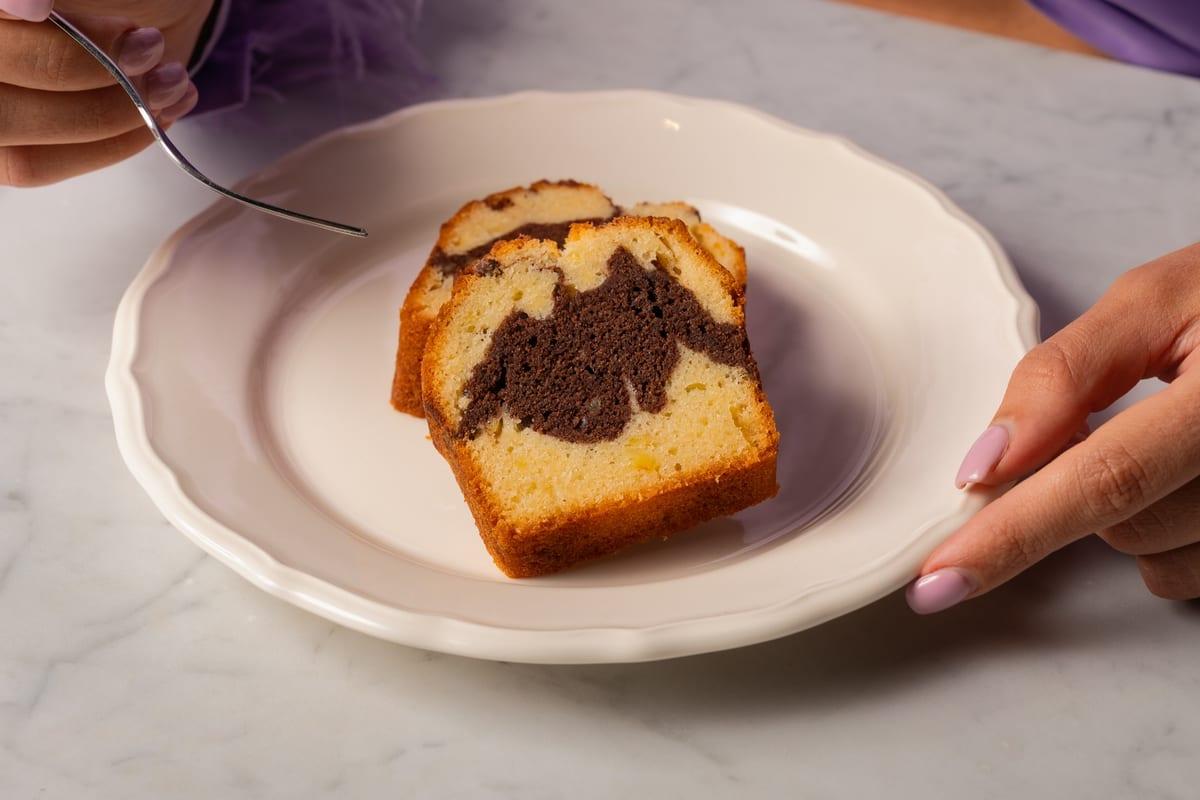
A marble cake loaf is the most practical cake you can keep in a Dubai kitchen or an office pantry. It holds well for three or four days at room temperature, it slices cleanly without crumbling, and it travels in a car in August without turning into a puddle of ganache. That combination is rare, and it is entirely down to how a butter loaf is built.
This is a guide to the loaf format itself: how the marble crumb is actually made, why the swirl goes wrong when a baker is too enthusiastic, how to store a butter cake in real Dubai humidity, and how our four loaves differ so you can pick the right one.
Why a cake loaf beats a layer cake for a household or office
A layer cake is an event. It needs a fridge, a knife, plates, and a reason. Most weeks nobody has one.
A loaf answers a different question: what do you put out when six colleagues drift into the kitchen at three o'clock, or when someone arrives at your door unannounced. It needs no assembly. Butter cakes are relatively low in moisture and high in fat, so they stale slowly and stay stable at room temperature — no cream, no custard, nothing that needs chilling. A loaf that sits in a tin on the counter is a loaf that gets eaten.
The Marble Cake Loaf is 35 AED, the same as every loaf we bake. For an office of eight to ten people that is one afternoon comfortably covered, and the end slices are usually still good the next morning.
The shape matters too. A loaf tin gives you a deep, narrow crumb, which means every slice has the same ratio of edge to middle. Cut it at about 1.5 cm and you get a slice that stands up on a plate and does not fold over when someone picks it up.
How a marble crumb is really made
Marble is not one batter with cocoa stirred through it. It is two batters, made from one base, folded together exactly once too few times rather than once too many.
We start with a creamed butter and sugar base — soft butter at around 19-20°C, beaten with caster sugar until pale and aerated, then eggs added slowly so the emulsion never breaks. Split that base in two. One half stays vanilla. The other takes cocoa powder and a small amount of extra liquid, because cocoa is a thirsty dry ingredient and will tighten a batter that is otherwise perfectly balanced. Both halves need to end up at the same consistency. If the chocolate batter is stiffer than the vanilla one, it will sit in blocks instead of ribboning.
Then the spooning. Alternate dollops down the length of the tin, two layers deep, then draw a skewer through in a single slow S from one end to the other. Once. Maybe twice. Every extra pass blurs the boundary between the two batters, and a batter that has been swirled six times bakes into a uniform pale brown cake that tastes vaguely of chocolate and looks like nothing at all.
We bake ours at a moderate 165-170°C for roughly 50-60 minutes. Lower and slower than you might expect, because a loaf is deep: a hot oven sets the crust before the centre has risen, and you get a domed crack with a raw seam underneath. The loaf is done when a skewer in the middle comes out with a few dry crumbs and the internal temperature is close to 96°C.
The last step is patience. Cool it in the tin for fifteen minutes, then on a rack, then leave it uncut for a few hours. A butter loaf cut while warm tears rather than slices, and the crumb has not finished setting.
Storing a butter loaf in Dubai humidity
Dubai does two things to a cake, and they pull in opposite directions.
Outdoors in August, humidity sits high and the air is warm. A loaf left uncovered goes tacky on the surface as it absorbs moisture. Indoors, the air conditioning runs dry and cold all day, and the same loaf left uncovered dries out at the cut face within hours. Whichever room you are in, the fix is the same: seal it.
Here is what works.
- Keep it whole for as long as you can. The crust is the wrapper. Cut only what you are about to eat.
- Press cling film against the cut face, then put the loaf in an airtight tin or box. Do not just drape the film over the top.
- Leave it at room temperature for three to four days. Do not refrigerate. Cold accelerates starch retrogradation, which is the technical name for the specific stale, dry, crumbly quality a fridge gives a butter cake.
- For longer than four days, slice it first, wrap the slices individually and freeze. They defrost at room temperature in about twenty minutes.
- A slice that has gone a little dry is excellent warmed for eight to ten seconds, or toasted lightly in a dry pan with a scrape of butter.
Which of the four loaves should you order?
All four are 35 AED and all four use the same creamed butter base, so the difference is flavour, sweetness and what they go with.
Marble Cake Loaf — the neutral one. Vanilla and cocoa, moderately sweet, no strong single note. This is the loaf to buy when you are feeding a group whose tastes you do not know, or when children are involved. It is also the best of the four with coffee, because it does not compete with it.
Classic Lemon Butter Cake Loaf — the bright one. Zest through the batter rather than only a glaze, so the citrus is in the crumb and not just on the surface; our lemon cake guide explains why zest does more than juice. It is the loaf that works best after a heavy meal, and the one that pairs properly with tea. Lemon loaves also improve on day two as the zest oils spread through the crumb.
Banana & Pecan Cake Loaf — the moist one. Ripe banana adds sugar and water, which means a denser, softer crumb and the longest keeping time of the four. Toasted pecans give it texture. This is the breakfast loaf, and our banana cake guide explains why the bananas have to be black.
Double Chocolate & Coconut Cake Loaf — the rich one. Cocoa plus chocolate, with coconut for a slightly chewy edge to the crumb. Order this when the cake is the point rather than the accompaniment. It is the least suited to a light afternoon and the best suited to a dessert plate. Our chocolate cake loaf guide covers why its cocoa goes into hot liquid first.
If you are ordering for an office and want one loaf, take the marble. If you can take two, marble and lemon give you the widest coverage: one comforting, one sharp.
What to serve with a marble loaf
Nothing, ideally. It is a cake that stands alone with a cup of coffee, and that is most of its job.
If you want to make more of it, a thick slice warmed slightly with a spoonful of thick yoghurt and a little date syrup makes a proper dessert. Or serve it cut into fingers alongside fresh fruit for a majlis table, where the low-fuss, no-cutlery format earns its keep. It also carries well as a gift, because unlike a cream cake it survives the journey.
We bake from Dubai Silicon Oasis and deliver across Dubai, so a loaf can arrive at a home or an office without anyone needing to plan a collection. You can see how that works on our delivery page.
Frequently Asked Questions
How long does a marble cake loaf stay fresh?
Kept whole and sealed in an airtight container at room temperature, a butter loaf stays good for three to four days. The cut face is what dries first, so press cling film directly against it. For longer storage, slice the loaf, wrap the slices individually and freeze them. They defrost at room temperature in around twenty minutes.
Should I keep cake in the fridge in Dubai?
No, not a butter loaf. Refrigeration speeds up starch retrogradation, which makes the crumb dry and crumbly far faster than leaving it out does. An airtight container at room temperature is better, even in summer, because the loaf contains no cream or custard. Freeze it instead if you need to keep it beyond four days.
What makes the swirl in a marble cake?
Two batters made from one creamed butter base — one vanilla, one with cocoa and a little extra liquid to match the consistency. They are spooned into the tin in alternating dollops and drawn through with a skewer in a single slow pass. Swirling more than once or twice blurs the two batters into a uniform brown crumb.
How many slices are in a cake loaf?
Cut at roughly 1.5 cm, a loaf gives you a generous set of slices that hold their shape on a plate. In practice one loaf comfortably covers an afternoon for a small office of eight to ten people, or a household across several days. Cut thinner for a tea table, thicker for dessert.
Which cake loaf is best for an office?
The marble loaf, because it has no strong single flavour and suits the widest range of tastes, including children. If you can order two, add the lemon loaf for contrast — one comforting, one sharp. All four loaves are the same price, so the choice is purely about who is eating.
Order a marble loaf
The Marble Cake Loaf is 35 AED, baked in Dubai Silicon Oasis and delivered across Dubai. Order it whole, keep it sealed on the counter, and cut it as you go through the week. You can see the rest of the loaves and everything else we bake in the shop.