22 August 2026
Chocolate Crinkle Cookie: How the Cracks Actually Form
The crackled white shell is not a decoration applied to the cookie but a crust that tears as the dough rises underneath it.
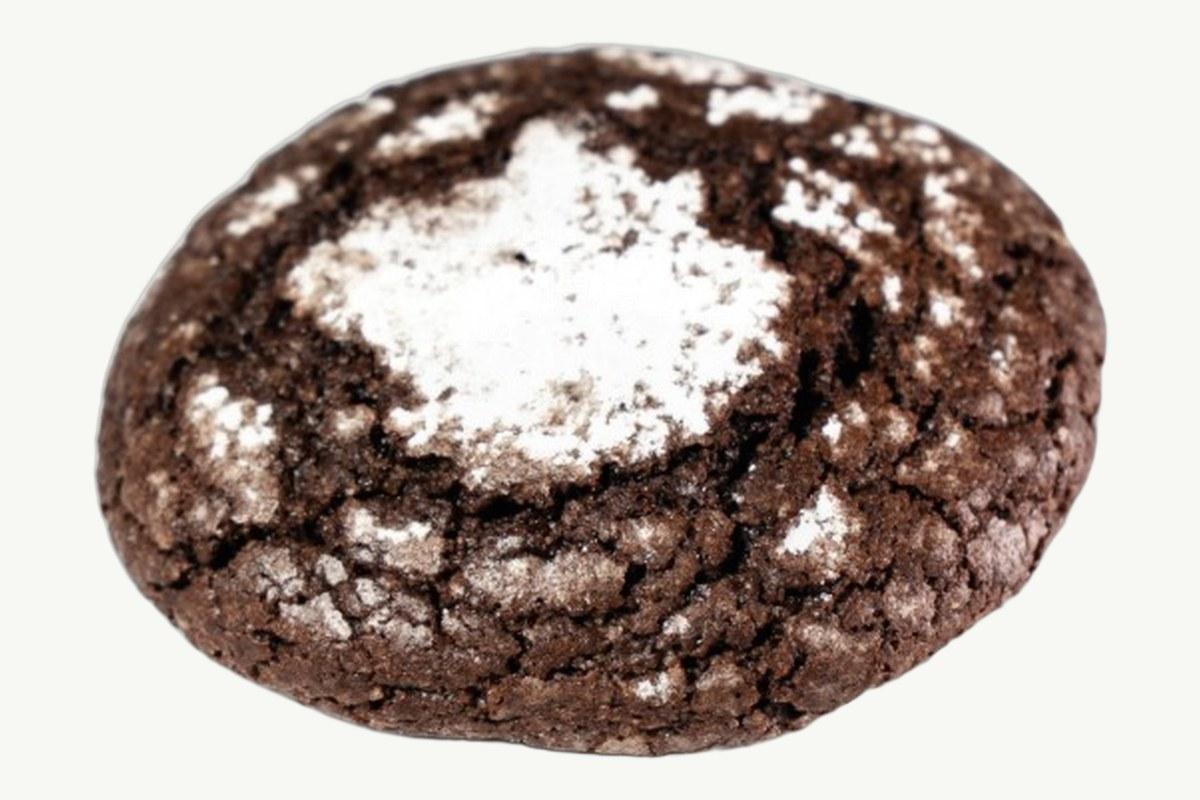
The question people ask about a crinkle cookie is almost always the same: how do you get the pattern. The honest answer is that you do not get it — you set up the conditions and the cookie does it to itself, in the oven, in the first few minutes.
Our Chocolate Crinkle Cookie is 14 AED and 80 g. What follows is the mechanism, and the three things that ruin it.
The crack is a crust tearing
Here is the sequence. A ball of dark, wet dough is rolled in sugar before baking — traditionally icing sugar, sometimes with a layer of granulated underneath it. That coating sits on the outside as a dry white shell.
In the oven, two things happen at once and at different speeds. The outside of the cookie dries fast, because it is thin and in contact with hot air, and the sugar coating dries with it into a brittle, rigid crust. Meanwhile the inside is still wet and full of leavening, and it starts to expand.
The crust cannot stretch. The interior is pushing outwards. So the shell fails — and it fails along lines of weakness, opening into fissures that reveal the dark dough underneath. That contrast between the white shell and the near-black interior is the whole visual.
Which means the pattern is a race. If the surface dries and sets before the interior has finished rising, you get deep, dramatic cracks. If the interior finishes rising before the surface sets, the dough simply flows and you get a smooth, mottled cookie with no pattern at all.
The three things that kill it
Skipping the chill. A cold dough ball is the single biggest factor. Cold dough holds its shape, so the surface has time to dry and set into a rigid shell before the middle warms enough to expand. Room-temperature dough starts spreading immediately, the surface never gets ahead, and no crust forms to crack. Chilling is not about convenience. It is the mechanism.
Too thin a sugar coat. The shell needs enough thickness to behave as a rigid layer. A light dusting dissolves into the surface moisture of the dough and disappears. A generous, fully covering roll — to the point where the ball looks like a snowball — survives the bake as a distinct layer.
Humidity. This is the local one. Icing sugar is hygroscopic, and in a humid kitchen a coated dough ball left sitting will draw moisture out of the air and out of the dough beneath it. The coating goes from powdery to damp and translucent, and a damp coating does not form a brittle crust; it melts into a glaze. In Dubai the practical rule is to coat the balls and get them straight into the oven, not to coat a whole tray and let it stand.
Why the inside stays fudgy
A crinkle dough is deliberately high in cocoa and comparatively low in flour, which gives a dense, brownie-like interior rather than an open cookie crumb. Cocoa absorbs a great deal of water, so the dough is wetter than it looks — that is why it needs chilling to be workable at all.
That wetness is what stays in the middle. The rigid shell that forms early actually helps here: it slows moisture escaping from the interior, so the centre finishes the bake softer than it otherwise would. The same crust that gives you the pattern is also insulating the fudgy middle.
It is the opposite construction to the Double Chocolate Chip Cookie, which is drier in the dough and relies on chocolate chips for its molten pockets. Here the whole interior is the soft part.
Storing it in this climate
The crinkle has a specific vulnerability that the other cookies on the board do not: its defining feature is a sugar shell, and sugar shells are the first thing humidity destroys.
Sealed in an airtight container while still even slightly warm, the cookie's own steam will condense on the shell and turn the white crust sticky and translucent within an hour. The pattern is still there but the contrast dulls and the texture goes tacky.
So cool them completely — genuinely completely, not nearly — before anything gets sealed. Then airtight, at room temperature. Do not refrigerate; the fridge is humid and cold, which is exactly the combination that softens the shell while firming the fudgy interior you wanted soft.
If the shell has already gone tacky, a few minutes in a low oven will drive the surface moisture off and bring back some of the crispness, though never quite all of it. Around 150°C for four or five minutes, then cool completely again before storing.
Serving
Unlike most of the board, this one is arguably better at room temperature than warm. Warming softens the sugar shell, and the shell is half the point. If you do want it warm, keep it brief and use dry heat so the surface stays dry.
It is intensely chocolatey and quite sweet, so it takes coffee well and takes salt even better — a few flakes on top before baking is a variation worth trying at home. Alongside the Lotus & White Chocolate Chip Cookie it makes a useful contrast on a shared board: one buttery, with its Lotus spread baked in pockets, the other dense and fudgy.
On nuts: the Pistachio Chocolate Chip Cookie and the Peanut Butter Cookie on the same board both contain them, and our kitchen handles peanuts and tree nuts. Our product descriptions are not full ingredient lists, so we cannot call the crinkle, or any item, nut-free. If you are avoiding nuts, ask us before you order.
Frequently Asked Questions
Why did my crinkle cookies come out smooth with no cracks?
Almost certainly the dough was not cold enough. Cold dough holds its shape while the surface dries into a rigid sugar crust; room-temperature dough spreads immediately, so no crust forms early enough to crack. Chill the portioned balls until genuinely firm, then coat and bake straight away.
Why did the white sugar coating disappear into the cookie?
Either the coat was too thin or the dough balls sat too long after coating. Icing sugar draws moisture from the dough and from humid air, dissolving into a glaze rather than staying as a powdery shell. Coat generously, until the ball looks like a snowball, and get it into the oven immediately.
Should I use icing sugar or granulated sugar for the coating?
Icing sugar gives the classic white contrast. A layer of granulated sugar underneath the icing sugar helps in humid kitchens, because the coarser crystals dissolve more slowly and act as a barrier that stops the icing sugar melting straight into the dough surface.
Why has the shell gone sticky in the container?
Trapped moisture, usually from sealing the cookies before they were completely cool. The cookie's own steam condenses on the sugar crust and turns it tacky. Cool them fully first. To recover a batch, give them four or five minutes at about 150°C, then cool completely again before sealing.
Does this cookie contain nuts?
Its description names no nuts, but that description is not a full ingredient list. Our kitchen handles peanuts and tree nuts, so we cannot call this cookie, or any item, nut-free. If you are avoiding nuts, or packing for a nut-free school, ask us before you order.
Order the chocolate crinkle cookie
The Chocolate Crinkle Cookie is 14 AED for 80 g, cracked in the oven rather than decorated afterwards. It sits with the rest of the cookie board on the shop, and our guide to choosing cookies by texture shows where it fits among the six.