The Pistachio Cookie in Dubai: Real Nut vs Green Colouring
Real pistachio is dull olive, never neon — how to spot the difference, and why a nut-heavy dough needs a longer rest.
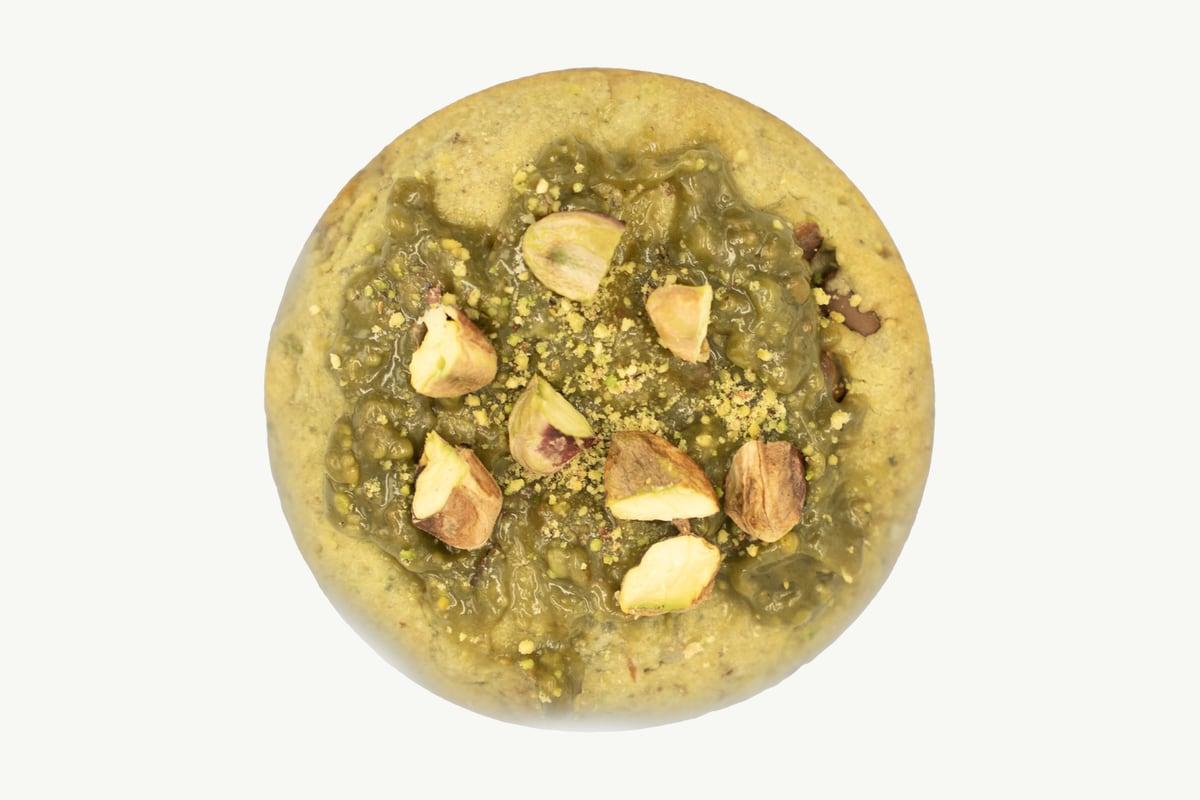
Pistachio is one of the most imitated flavours in the region right now. Plenty of what is sold as pistachio is almond or cashew paste carrying a green dye and a little flavouring, because real pistachio kernels cost considerably more than almond kernels and the natural colour is far less photogenic. The tells are learnable in about a minute, and once you know them you cannot unsee them.
This is a close look at one cookie — our Pistachio Chocolate Chip Cookie at 18 AED, a chocolate chip cookie topped with pistachio cream and roasted pistachios — and at why pistachio, whether worked into a dough or spread on top of one, behaves differently from a plain chocolate chip cookie.
How to tell real pistachio from green colouring
Colour. Real pistachio is a dull, muted olive, often with a khaki or grey cast and a faint purple blush on the skin from anthocyanins. It is not vivid. If a filling or a cookie interior is a bright, uniform emerald or that saturated mint-green of a bubblegum ice cream, you are looking at dye. The green in a pistachio comes from chlorophyll, and chlorophyll is heat-sensitive: it degrades in an oven and drifts towards brown-olive. So the most reliable test costs nothing — anything that stays neon after baking has been coloured, because a real nut would have dulled.
Smell. Pistachio is quiet. It reads green and faintly resinous, closer to green tea or pine than to marzipan. Almond paste announces itself with benzaldehyde, the sharp cherry-almond note in almond extract. If the aroma hits you before the nut does, it is probably not pistachio.
Texture. Ground pistachio is oily and slightly coarse; it smears rather than powders, and a paste made from it separates over time and needs stirring. Almond paste is smoother, drier and more stable, which is precisely why it is so widely used as a stand-in.
Price. Pistachio kernels sit at the expensive end of the nut shelf, well above almonds, and any product using them in quantity has to reflect that somewhere. A strong green colour attached to a soft price is telling you what is inside. The same tests work on pastry fillings too, as our pistachio croissant guide shows.
Why pistachio fat behaves differently from almond
Nuts are mostly fat, but not the same fat. Pistachio oil is largely unsaturated and stays soft and fluid at room temperature, more so than almond, which is one reason ground pistachio never firms into a tidy paste the way marzipan does.
That has three consequences in a dough. It stays soft in the fridge, so a rested pistachio dough is less rigid than a plain one and needs firmer handling when you portion it. It carries flavour differently — fat-soluble aromatics disperse through the whole crumb rather than sitting on the surface, which is why pistachio tastes like it is in the cookie. And it goes off faster: unsaturated fats oxidise more readily than saturated ones, and heat and light accelerate that, which matters in a Dubai kitchen.
What nuts do to the crumb, and why the dough rests longer
Flour and water make gluten. Nuts make neither. When you work a meaningful quantity of ground and chopped pistachio into a cookie dough, you are doing two things at once.
The nut particles physically interrupt the gluten network. Strands cannot run the length of the cookie, so the chew shortens — the crumb pulls a little, then gives, rather than stretching like a plain chocolate chip cookie. That is the texture you want here, and it is why a nut cookie can carry more flour strength without turning tough.
At the same time, nut oil coats the flour and slows hydration. Water has to work past a film of fat to reach the starch. Straight after mixing, a pistachio dough looks and feels drier than it should. Give it twenty-four hours and it is still only halfway there. A dough like that wants two to three days in the fridge, longer than a plain dough needs, and in that window three things resolve: the flour finally hydrates fully, the nut oil migrates outwards and binds the dough into something cohesive and pliable, and the flavour rounds off the raw green edge into something toasted and sweet.
Skip the long rest and you get the classic fault of a home-made nut cookie — a dough that spreads unevenly, a gritty patch where the flour never wetted, and a flat nut flavour.
Why it should be underbaked in the centre
Two things push this cookie towards a shorter bake than you would give a plain one.
First, the exposed pistachios on top. Nut oil browns fast and burns before the dough around it is done, and burnt pistachio is genuinely bitter — it takes the whole cookie with it. So the oven runs moderate rather than hot: around 180°C fan, not 200°C, with the topping chopped coarsely so the pieces are chunky enough to survive. Fine chopped nuts on the surface scorch almost immediately.
Second, a nut-heavy dough carries less free water than a plain one. It sets less from starch gelatinising and more from fat re-solidifying as it cools, which means it firms up considerably on the tray after it leaves the oven. Bake it until the centre looks set and you have overshot by several minutes' worth of carry-over.
The cookie comes out when the outer ring is coloured and firm and the middle still looks wet, slumped and faintly raw. It finishes on the tray over about five minutes. If you want the opposite reading on the same principle, our Double Chocolate Chip Cookie at 18 AED takes the underbake window further still: cocoa absorbs water aggressively and contributes no gluten, so it is pulled even softer and sets into something closer to a brownie edge.
Keeping and reviving a pistachio cookie in Dubai
Nut cookies are more fragile in this climate than plain ones, for the reason above — unsaturated oil and heat are a poor combination.
- Airtight container, room temperature, away from any window that gets direct sun. A closed cupboard beats a glass jar on the counter every time here.
- Do not refrigerate. Cold air is dry air; it firms the fat, stales the crumb and pulls flavour out of the nuts.
- Two to three days is the sweet spot. Beyond that they are still good, but the pistachio starts to lose its top note.
- To keep them longer, wrap individually and freeze. They come back on the counter in around twenty minutes with no real loss.
- If a nut cookie ever smells faintly of old crayon or paint, the oil has oxidised. That is the one signal worth trusting over a date.
To revive one that has firmed up: three or four minutes in a low oven, around 150°C, no more. That softens the butterfat and the chocolate without cooking the centre further or scorching the nuts on top. Eat it with something bitter opposite — a short black coffee, or Arabic coffee with cardamom, which meets the resinous side of the pistachio properly. We bake in Dubai Silicon Oasis and deliver across Dubai, so a box arrives fresh rather than after a week in a warehouse; the details are on our delivery page.
Frequently Asked Questions
How can I tell if a pistachio cookie uses real pistachios?
Look at the colour after baking. Real pistachio is a dull olive with a khaki or grey cast, because chlorophyll degrades in oven heat. Anything that stays vivid emerald has been coloured. Smell it too — genuine pistachio is quiet and faintly resinous, while almond paste gives off a sharp cherry-almond note.
Why is pistachio so much more expensive than other nut flavours?
Pistachio kernels sit at the expensive end of the nut market, well above almonds and cashews. The trees crop heavily only in alternate years, and shelling and peeling the kernels adds cost. That gap is why so many products substitute a cheaper nut paste with green colouring and rely on the appearance rather than the ingredient.
Why does pistachio cookie dough need a longer rest than plain dough?
Nut oil coats the flour and slows down hydration, so water takes far longer to reach the starch. Twenty-four hours is not enough. Two to three days lets the flour hydrate fully, allows the oil to migrate through and bind the dough, and rounds the raw green flavour into something toasted.
Should a pistachio cookie be soft in the middle?
Yes. A nut-heavy dough holds less free water and sets mainly as its fat cools and re-solidifies, so it firms considerably on the tray after leaving the oven. It should come out with a coloured, firm outer ring and a centre that still looks wet. Baking until the middle looks done overshoots it.
How should I store cookies in Dubai's summer heat?
Airtight container at room temperature, in a closed cupboard away from direct sunlight, never the fridge. Nut cookies matter more than most because unsaturated oils oxidise faster in heat and light. Two to three days is best. For longer, wrap them individually and freeze, then bring them back on the counter for twenty minutes.
Order the pistachio cookie
The Pistachio Chocolate Chip Cookie is 18 AED: a chocolate chip cookie topped with pistachio cream and roasted pistachios. Pair it with the Double Chocolate Chip Cookie at 18 AED if you want one nutty and one fudgy on the same plate. Both are in the shop, baked in Dubai Silicon Oasis and delivered across Dubai, and our guide to choosing cookies by texture covers the other four.