16 September 2026
Pistachio Croissant Dubai: How the Filling Changes the Flake
A pistachio croissant should taste of the nut before the sugar, and its filling and glaze change the layers around them.
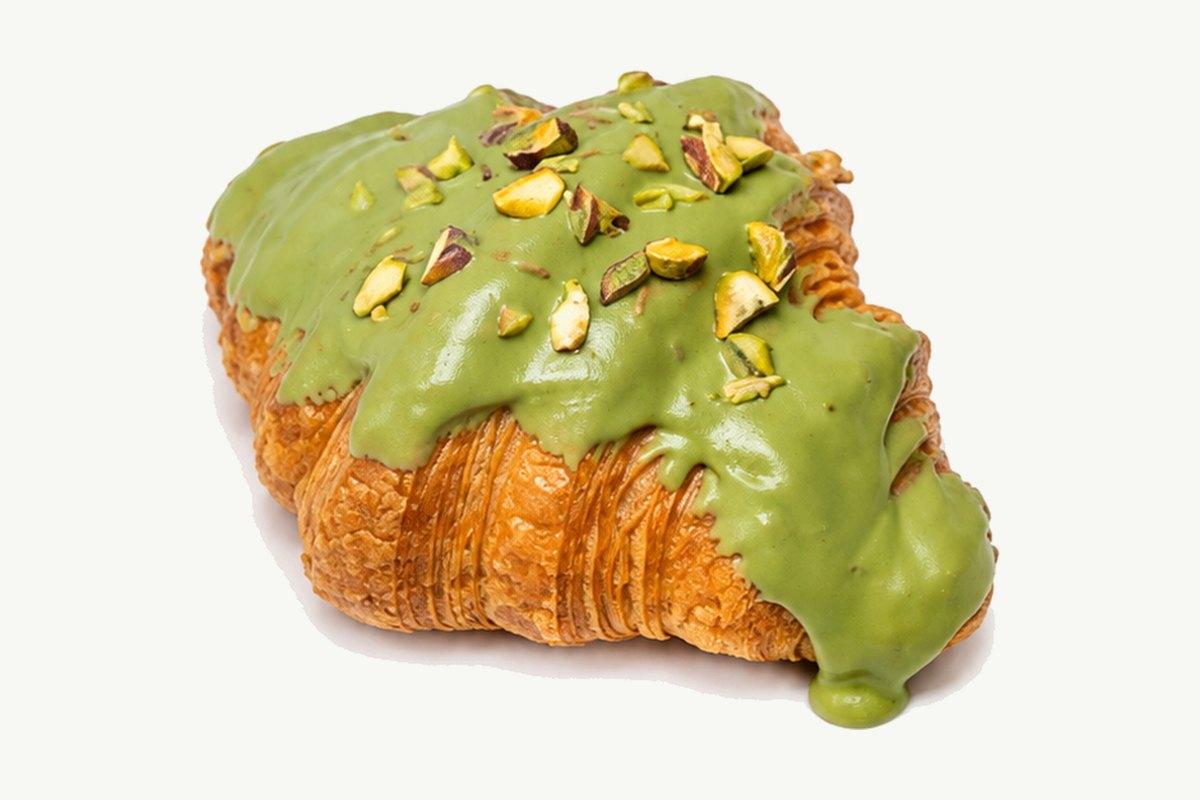
When a pistachio croissant disappoints, the fault is usually in one of two places. Either the filling tastes of sugar first and nut a distant second, or the layers around the filling and under the glaze have turned soft and doughy. Good lamination still matters, but with pistachio it is only where the judging starts.
Both faults are easy to miss at first glance, because a glaze and a scatter of crushed nuts hide the top of the bake. The Pistachio Croissant we bake has exactly that build: a croissant layered with buttery flakes, filled with creamy pistachio paste, and finished with crushed pistachios and a light glaze. It costs 19 AED.
What a good pistachio filling should taste of
Pistachio tastes green and slightly savoury, with a buttery richness that deepens when the nuts are roasted, and it is easily drowned. A filling that tastes mainly sweet, with the pistachio arriving late and faint, is usually leaning on sugar rather than nut.
So taste for the order of things. The nut should come first, the sweetness second, and the finish should linger as pistachio rather than as sugar. A good filling is creamy but not gluey. A pastry has no label to read, so taste a little of the filling on its own before the layers around it.
Colour is the other tell, but judge it on the filling, not the coating, because a glaze's colour comes from whatever the glaze is made of. Pistachio in a filling is soft and muted, never neon, and it dulls further in the oven because chlorophyll breaks down with heat.
We went through colour, smell, texture and price in more depth in our guide to how to tell real pistachio from green colouring. For pistachio in a different bake, our Pistachio Chocolate Chip Cookie at 18 AED is topped with pistachio cream and roasted pistachios.
How a filling and a glaze change the bake
Underneath, it is still a laminated pastry: sheets of butter and dough that separate when the water in the butter turns to steam. We covered that process, and how to read the honeycomb it leaves behind, in our guide to how lamination builds those layers.
A filling brings fat and moisture inside. If the filling is baked in, the layers it touches cannot fully dry out and separate the way the exposed ones do; if it is piped in after baking, it softens them gradually instead. A narrow band of softer, richer pastry around the filling is normal, and part of the pleasure. A thick, grey, doughy seam is not. It usually means a very wet filling or pastry that was not baked through.
The type of filling decides how it softens. A pastry cream is mostly water, and water is what turns crisp layers soft. Ours is filled with creamy pistachio paste. A paste made from ground nuts is rich in fat and very low in water, so it softens the neighbouring layers far more slowly, although its oil will still seep into them over a few hours, because pistachio oil stays fluid at room temperature. That is one more reason to eat this pastry the day it arrives.
Heat is hard on pistachio. Almond cream, the filling in our Almond Cream Croissant, is made to be baked: it sets in the oven and browns at the edges, as we explain in what almond cream does inside a croissant. Pistachio is more delicate. Long oven time dulls its fresh, green aroma as well as its colour, so a filling with plenty of nut in it has flavour to spare, while a thin one goes flat quickly.
A glaze changes the surface. Fat-based coatings, such as the tempered chocolate on a dipped chocolate croissant, contain almost no water and seal the crust. Sugar does the opposite: it pulls water from the air, so in humid weather a sugary top turns tacky and softens the crust beneath, the same problem as a cookie croissant's topping. Either way, a glaze brings sweetness of its own, so the filling underneath needs enough real nut to hold its ground.
Crushed nuts on top add texture. They bring crunch and nut aroma to the first bite, but they tell you nothing about the filling inside.
How to judge a pistachio croissant when you break it open
Because the glaze covers the top, judge the bake from the sides and base: deep golden brown, with the lines of lamination clearly visible. If the sides bend rather than crackle, the pastry was either underbaked or has taken on moisture from the air.
Then pull it apart. The filling should taste of pistachio in more than one bite rather than in a single mouthful, and the glaze should bite cleanly rather than stretching like toffee.
Why pistachio pastry is having a moment in Dubai
Pistachio is not new here. It has been part of the region's sweets for generations: scattered over kunafa, layered through baklava, pressed into ma'amoul, and paired with cardamom and rosewater in milk puddings and ice creams from the Levant to Iran and South Asia. It is a festive nut, the one on trays of sweets at celebrations.
What changed is the format. In a city where French pastry and regional sweets share the same counters, pistachio is a natural bridge. Then filled chocolate bars from Dubai, packed with pistachio cream and crisp shredded pastry, travelled the world on social media, and "Dubai-style" became shorthand for pistachio and crunch. Now the nut is in croissants, cookies, lattes and ice cream all over town. Ours keeps to a classic filled format, with the paste inside and the nuts on top.
Pistachio kernels cost considerably more than almonds, so a boom in demand brings a matching temptation to stretch the nut with green colouring and sugar.
How to eat, store and reheat a pistachio croissant
Eat it the day it arrives, at room temperature. That is when the outer layers are crisp and the pistachio aroma is brightest. Cold firms a nut filling and mutes its aroma.
Tear it, or use a serrated knife. A straight blade presses down and squeezes the filling out of the far end. Use a plate, too: a well-laminated croissant sheds flakes and nuts everywhere.
Keep it in paper at room temperature, out of the sun and out of the fridge. Humidity softens laminated pastry in Dubai, and a sealed plastic box traps it, turning the crust leathery and the glaze soft. The fridge is no better: a cold pastry carried into humid air collects condensation on its glaze. Never leave it in a hot car. Our guide to storing bread and pastry in Dubai covers the rest of the range.
Freeze it only if you need to. Eat it on the day if you can: it freezes less gracefully than a plain croissant, because condensation as it thaws can leave the glaze tacky or dull. If you do freeze it, wrap it the same day it arrives, use it within a week, and thaw it in its wrapping until it reaches room temperature, so the moisture settles on the wrapping, not the glaze.
Warm it gently, if at all. To revive one that has softened, use a low oven, around 150 to 160°C, for three to four minutes, on baking paper in case the glaze runs, and away from the grill element, which scorches crushed nuts. An air fryer blows hot air straight across the crushed nuts, so set it lower than you would for a plain croissant and check after two minutes. Either way, let it stand for five to ten minutes: the dense filling holds heat longer than the airy layers, and a warmed glaze needs time to firm again. Skip the microwave, which steams the layers soft and makes the filling scalding.
What to drink with a pistachio croissant
This is a rich pastry, so it wants something bitter, tannic or at least unsweetened beside it rather than more sugar.
- Espresso or a short black. Its bitterness balances the butter and leaves room for the pistachio.
- A flat white or cortado. A small, unsweetened milky coffee suits a pastry this rich without adding sweetness of its own.
- Arabic coffee with cardamom. Cardamom already sits beside pistachio in many of the region's sweets, and a lightly roasted, unsweetened coffee keeps the pairing from turning heavy.
- Green or black tea, unsweetened. Pistachio's resinous notes sit comfortably beside green tea's grassiness, and the tannins in either keep the butter from feeling heavy.
Skip anything sweetened or pistachio-flavoured alongside it; it only competes with the filling.
Frequently Asked Questions
How much is a pistachio croissant in Dubai at Farah Bakery?
Our Pistachio Croissant is 19 AED per pastry. On the same board, the plain Croissant is 14 AED, the Almond Cream Croissant is 18 AED, and the Chocolate Croissant and Cookie Croissant are 16 AED each. You can order any of them from our shop for delivery across Dubai.
What is inside Farah Bakery's pistachio croissant?
It is a butter croissant filled with creamy pistachio paste and finished with crushed pistachios and a light glaze, so it contains at least pistachios (tree nuts), wheat (gluten) and dairy (butter); the description is not a full ingredient list. Our kitchen handles wheat, gluten, eggs, dairy, nuts, peanuts, soy, sesame and seeds, and we cannot guarantee any item is free from traces of these. If you have an allergy or intolerance, ask us before ordering and do not rely on this description alone.
What is the difference between a pistachio croissant and an almond croissant?
Mainly the filling, and how it handles heat. Almond cream is made to be baked: it sets in the oven and browns at the edges, and our Almond Cream Croissant is topped with toasted almonds. Our Pistachio Croissant is filled with creamy pistachio paste and finished with crushed pistachios and a light glaze. Pistachio is the quieter, greener-tasting nut, and long oven heat dulls its colour and aroma. Ours are 18 AED for the almond and 19 AED for the pistachio.
How do you reheat a pistachio croissant?
Reheat it only if it has gone soft; on the day it arrives it is best at room temperature. Otherwise give it three to four minutes in a 150 to 160°C oven, lower than for a plain croissant because the glaze can run and crushed nuts scorch, then let it rest for five to ten minutes so the filling cools and the glaze firms again. A microwave turns the layers soggy.
Can you freeze a pistachio croissant?
You can, though it is better eaten on the day, because a glazed pastry freezes less well than a plain croissant. If you must, wrap it well the same day it arrives and use it within a week. Let it thaw in its wrapping so the moisture forms on the wrap rather than the glaze, then warm it gently in a low oven, never a microwave.
Taste the pistachio filling for yourself
Everything we sell is baked to order for the day it is due, and there is no same-day delivery: our earliest delivery window is the next morning, and you choose a delivery window at checkout. The Pistachio Croissant costs 19 AED and comes from our kitchen in Dubai Silicon Oasis; eat it the day it arrives, at room temperature. To see what the filling and glaze add, put a plain Croissant at 14 AED in the same box and taste the two side by side, or add a Chocolate Croissant at 16 AED alongside them.