23 August 2026
Cookie Croissant: What Happens When a Croissant Is Baked Twice
A cookie croissant is not a croissant with cookie dough on top. It is a croissant that has been through the oven twice, for two different reasons.
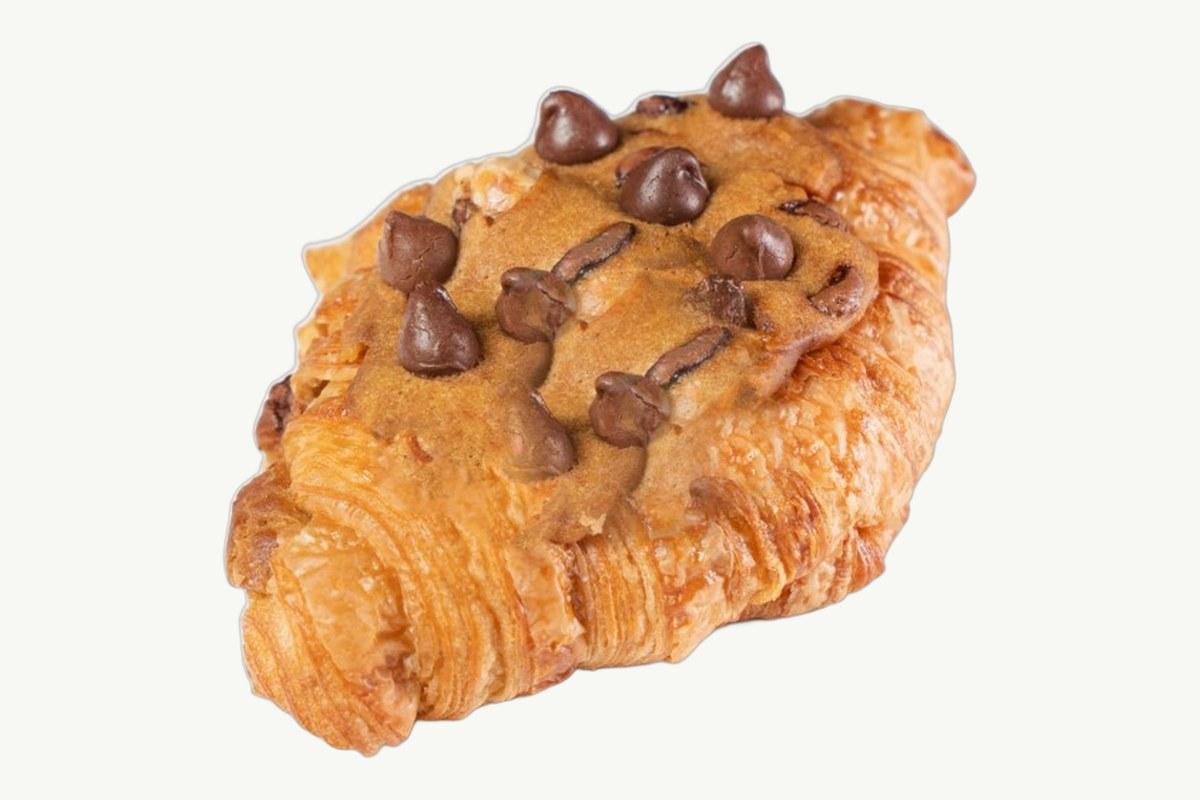
The cookie croissant looks like a shortcut — take a croissant, put cookie dough on it, bake. In practice it is the most technically awkward thing on our pastry board, because it asks one object to be two things that want opposite conditions. A croissant wants a hot, fast bake and then to be left alone. A cookie wants a moderate bake and a soft centre. Putting them together means the croissant goes through the oven twice, and the second pass is where it can all go wrong.
Our Cookie Croissant is 16 AED. Here is how it is built and why the order of operations matters.
Why the croissant is baked first
You cannot laminate cookie dough onto a raw croissant and bake them together. The two need different things at the same moment.
A raw croissant relies on steam. The butter layered between the dough sheets melts, releases water as steam, and that steam pushes the layers apart — this is the entire mechanism that produces a croissant's honeycomb interior. It needs high heat, fast, and it needs the surface free to expand.
Cookie dough spreads and sets at a lower temperature over a longer time. Put it on top of a raw croissant and it acts as a lid: it weighs the surface down, traps the steam, and stops the lift. You end up with a dense, greasy pastry that never opened, wearing a burnt cookie.
So the croissant is baked properly on its own first. Full heat, full lift, honeycomb established, cooled. Only then does the cookie dough go on, and it goes back into a cooler oven for a second, shorter bake that sets the topping without destroying what is underneath.
What the second bake does to the lamination
This is the real question, and the honest answer is that it costs you something.
A croissant straight out of its first bake is at its structural peak: the layers are crisp, dry and separated. Any further time in an oven drives more moisture out of those layers, and past a point they stop being crisp and start being brittle and dry.
Worse, the cookie dough on top is wet. As it bakes it releases moisture downwards into the croissant's crust, softening exactly the surface you spent the first bake crisping.
The second bake is therefore short and cooler than the first — enough to set the cookie dough and let it spread into a shell, not enough to dry the pastry out beneath it. Get it right and the contrast is the point of the thing: a crisp, slightly chewy cookie lid over a still-flaky interior. Get it wrong in either direction and you have a soggy croissant under a raw topping, or a bone-dry one under a hard biscuit.
It is also why this pastry is much less forgiving of sitting around than a plain Croissant. The plain one has one moisture gradient to lose. This one has a wet topping sitting on a dry crust, and the two equalise faster than you would like.
Why it goes stale differently
A plain croissant goes stale by losing water: the layers dry, the shatter turns to a dull snap, and the crumb firms. The fix is heat, which drives out the moisture that has migrated into the crust.
A cookie croissant goes stale the other way round. The cookie topping is hygroscopic — sugar attracts water — so it pulls moisture out of the air in a humid Dubai kitchen, and pulls it out of the croissant underneath at the same time. Several hours in, the topping has gone soft and slightly tacky while the pastry below has gone limp rather than dry.
That distinction matters for reviving it, because the instinct — wrap it up to keep it fresh — is precisely wrong. Wrapping traps the moisture that is doing the damage.
Bringing one back
Dry heat, moderate, and unwrapped.
Oven. Preheat to about 180°C. Put the croissant straight on a rack or a preheated tray for five to six minutes. That is lower and longer than you would use for a plain croissant, because you are trying to drive moisture out of both the topping and the pastry without re-melting the cookie shell into a puddle.
Air fryer. 160°C for three to four minutes. Watch it closely — the moving air browns a sugar topping fast, and a cookie lid goes from golden to burnt in well under a minute.
Never a microwave. The sugar in the topping heats far faster than the pastry, so you end up with a molten, sticky lid over a steamed, collapsed croissant. Of everything on our board this is the one that microwaves worst.
Let it stand for two or three minutes afterwards. The topping is molten straight out of the oven and needs to set back into a shell before it will read as a cookie again.
How it compares to the rest of the croissant board
If you want the lamination itself to be the experience, the plain Croissant is the honest answer — nothing on top, nowhere to hide, and it is the one that tells you whether a bakery can laminate.
The Almond Cream Croissant is the closer cousin technically, because, as our almond croissant guide explains, it is also a twice-baked pastry: baked, filled, topped and returned to the oven. Almond cream behaves differently from cookie dough — it is wetter and sets softer, so it soaks into the pastry deliberately rather than sitting on top of it.
The Chocolate Croissant is the simplest of the group and the one that holds up best over a few hours, because there is no wet topping equalising with the crust.
The Pistachio Croissant is filled with pistachio paste and finished with a light glaze. Our pistachio croissant guide explains why a sugary top on any croissant goes tacky in humid air in much the same way a cookie lid does.
Side by side, the five are a decent short course in what a filling or a topping does to a laminated pastry.
Frequently Asked Questions
Why is a cookie croissant baked twice instead of once?
Because the two components need opposite conditions. A raw croissant needs high heat and a free surface so steam can push the layers apart, while cookie dough on top acts as a lid that traps the steam and stops the lift. Baking the croissant fully first, then adding the topping for a second cooler bake, is the only way both work.
Why did mine go soggy after a few hours?
The cookie topping draws moisture from the air and from the pastry beneath it, so the crust softens from underneath rather than drying out. Humid conditions accelerate it. Storing it wrapped makes it worse by trapping that moisture — leave it loosely covered and revive it with dry heat instead.
What is the best way to reheat one?
About 180°C for five to six minutes, unwrapped, straight from the counter rather than the fridge. That is cooler and longer than a plain croissant because you need to dry both the topping and the pastry without melting the cookie shell. An air fryer at 160°C for three to four minutes also works if you watch it.
Can I microwave it?
This is the worst thing on our board to microwave. Sugar heats much faster than pastry, so the topping goes molten and sticky while the croissant beneath steams and collapses. If you have no oven, a dry pan on low heat with a lid for a minute is a better fallback.
How is it different from an almond cream croissant?
Both are twice-baked, but the fillings behave differently. Almond cream is wet and sets soft, so it deliberately soaks into the pastry and softens it as part of the design. Cookie dough sets firm and sits on top as a distinct shell, so the contrast between crisp lid and flaky interior is the whole point.
Order the cookie croissant
The Cookie Croissant is 16 AED, baked twice because there is no shorter route to it. Take it warm if you can, and give it five minutes at 180°C if you cannot. It sits with the rest of the croissant board on the shop.