16 August 2026
Croissant Dubai: How Lamination Makes or Breaks the Bake
The plain croissant is the fairest test of any bakery — here is what happens inside one, and how to read its cross-section.
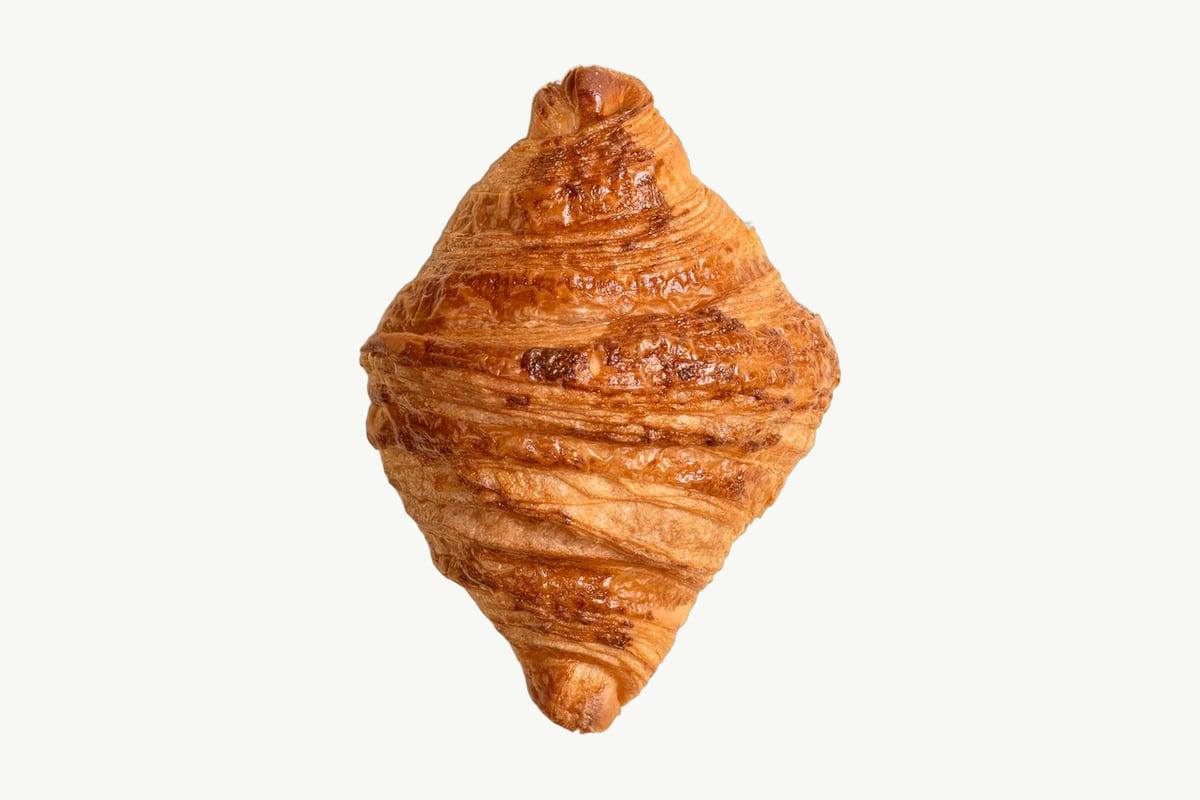
A plain croissant is flour, butter, water, salt, sugar and a little yeast. There is nothing to hide behind, which is why it is the hardest thing in our bakery to get right and the fairest way to judge any pâtisserie. If you want to know whether a place can bake, order the Croissant at 14 AED, tear it open, and read the cut face before you taste anything.
Why the plain croissant is the hardest thing in the bakery
Most pastries let you compensate. A filling covers a dry crumb; a glaze covers a pale bake; sugar covers under-fermentation. A plain croissant offers no cover. Every decision — the flour, how cold the room was at the second fold, how patient you were during the prove — ends up visible in the crumb and audible when it breaks.
It is also the most temperature-sensitive thing we make. The dough wants to be cold, the butter cool but pliable, the prover warm but not so warm that the butter gives up. Getting all three right on the same August morning in Dubai is the whole job.
Lamination, step by step: détrempe, butter block, 27 layers
Lamination traps sheets of butter between sheets of dough so that, in the oven, the water in the butter turns to steam and pushes the layers apart. Done properly it is not a folding trick — it is engineering.
The détrempe. The base dough: flour, water, milk, salt, sugar, a little yeast, mixed deliberately short. You want enough gluten to hold a sheet without tearing, but not so much elasticity that the dough fights the roller and shrinks back. It rests cold overnight, which relaxes the gluten and lets a slow, flavourful fermentation begin at a temperature where the yeast works quietly rather than racing.
The butter block. A high-fat European-style butter, around 82 to 84 per cent fat, so there is less water and more of what makes a croissant taste of butter rather than pastry. The block is beaten and squared into an even slab, then brought to roughly 14 to 16°C. That number matters more than any other here.
The folds. The chilled détrempe is rolled out, the butter laid in, the dough sealed around it. Then three single folds, each a simple letter fold in thirds: one fold gives three layers of butter, two gives nine, three gives 27. Between each fold the dough goes back to the fridge for 30 to 45 minutes — non-negotiable. Fold without that rest and the gluten is too tight, the sheet tears, and butter squeezes through the wound.
Twenty-seven is the number we like. Higher and the butter layers become so thin they dissolve into the dough, giving something closer to brioche; lower and the layers are coarse and the pastry feels heavy. The block is then sheeted to around 3 to 3.5 millimetres, cut into long triangles, and rolled with light, even tension. Roll too tightly and the centre cannot expand, giving the dense doughy core bakers call the bread stripe.
Why the butter has to stay plastic, and what Dubai does to it
Butter behaves in three ways depending on temperature, and only one is useful.
Below about 12°C it is brittle. Roll it and it shatters into shards inside the dough. Those shards do not form continuous sheets, so steam escapes sideways instead of lifting, and the pastry ends up patchy with dense pockets. Above about 20°C it melts, soaking into the flour and greasing the dough. Once that happens the layers are gone permanently — no amount of folding brings them back, and the pastry bakes short and crumbly, more like a biscuit.
Between roughly 14 and 16°C butter is plastic: it bends and stretches without breaking and without weeping oil, behaving like clay. That is the only state in which it will roll into a continuous sheet a fraction of a millimetre thick and stay there.
Holding that window in Dubai means a genuinely refrigerated lamination room, not a cool corner and good intentions. Ambient here is often above 40°C, and a stainless bench holds that heat. Marble helps; a cold room helps more. We work in short bursts and would rather stop mid-fold than push on with softening butter.
Proving: the slowest stage, and the one that fails first
Shaped croissants prove at around 24 to 26°C with high humidity, and it takes two to three hours. It cannot be hurried, because the ceiling is set by the butter, not the yeast. Push the prover above about 28°C and the butter softens past plastic and leaks — a slick of fat on the tray before the pastry ever reaches the oven, and a bake that is greasy at the base and short of volume.
Under-proved croissants are dense and tight. The steam has nowhere to go gently, so it blows out — a burst side seam and a heavy, slightly gummy middle. Over-proved ones have stretched past what the gluten can hold, so they collapse in the oven, leak butter, and come out flat with a coarse, torn crumb.
The window between the two is maybe twenty minutes wide. Judged by eye, the croissant should have visibly grown, feel light when the tray is lifted, and wobble like jelly when the tray is shaken. Then it is egg-washed on the top surfaces only — never into the cut edges, where the wash glues the layers shut — and baked at around 200°C, falling to 180°C, for 16 to 18 minutes. No steam injection: the butter supplies all the steam a croissant needs from the inside.
How to judge a croissant by its cross-section
Tear one open rather than cutting it — a knife compresses the crumb and lies to you.
You want a honeycomb: irregular oval cells with thin, glossy, translucent walls, running the length of the pastry and reaching all the way to the centre. The cells should be uneven in size; perfect uniformity usually means over-laminated dough.
What you do not want: a solid pale core in the spiral, meaning it was rolled too tightly or under-proved; a single large tunnel with dense walls, meaning the layers merged; a greasy, wet cut face, meaning the butter melted somewhere; a soft, bendy exterior, meaning it under-baked or sat in a humid display case.
A real croissant also makes a mess. Properly separated outer sheets are dry, shatter-thin and only loosely attached, so they fall off the moment you bite. Flakes on the table are the evidence, not sloppy baking. A croissant that stays neat has no shell worth speaking of.
Once you can read a plain one, the filled versions are easy to assess too. Our Almond Cream Croissant at 18 AED and Chocolate Croissant at 16 AED start from exactly the same laminated dough, so the same rules apply to their edges and their lift. The almond croissant, chocolate croissant, cookie croissant and pistachio croissant guides take each one apart.
How to keep and revive a croissant in Dubai
Humidity is the enemy of a shell that took so long to build. Summer air here moves straight into a crisp crust and softens it within an hour or two.
Never store croissants in a sealed plastic box — trapped moisture turns the outside leathery. Never refrigerate them either; fridge temperatures speed up starch retrogradation and stale the crumb faster than the counter would. A paper bag, eaten the same day, is the honest answer. For anything longer, wrap and freeze them within a few hours of baking, then revive straight from frozen at 160 to 170°C for five to six minutes. The trapped moisture flashes back to steam and the shell re-crisps well. A microwave does the opposite.
We bake to order, each morning, for the day an order is due, and deliver across Dubai from Dubai Silicon Oasis — which is the short version of why a croissant from us comes from that morning's bake rather than from a day in a display case.
Frequently Asked Questions
Why does a good croissant leave flakes all over the plate?
Because the outer layers have been separated by steam and baked dry, leaving thin, brittle sheets only loosely joined to the body of the pastry. Biting one shatters them. A croissant that cuts cleanly and leaves no crumbs usually has under-developed lamination, or has absorbed moisture from humid air.
What is the ideal butter temperature for lamination?
Roughly 14 to 16°C. In that range butter is plastic: it stretches into continuous paper-thin sheets without cracking or melting. Below about 12°C it shatters into shards and the layers break up. Above about 20°C it melts into the flour, the layers merge permanently, and the pastry bakes short rather than flaky.
How many layers should a croissant have?
Three single folds give 27 layers of butter, which is the classic count and the one we use. More layers are not better — beyond a certain point each butter sheet becomes so thin it is absorbed by the dough, and the result reads as soft enriched bread. Fewer layers give a coarse, heavy pastry.
How should I store croissants in Dubai's humidity?
Keep them in a paper bag at room temperature and eat them the same day. Avoid sealed plastic containers, which trap moisture and turn the crust leathery, and avoid the fridge, which stales the crumb faster than the counter does. For longer storage, wrap and freeze within a few hours of baking.
How do I revive a croissant that has gone soft?
Put it in an oven at 160 to 170°C for five to six minutes, or straight from frozen for the same time. Residual moisture turns to steam and re-crisps the outer layers. An air fryer at a similar temperature works in three or four minutes. Never use a microwave, which softens the shell further.
Order a croissant from Farah Bakery
Our Croissant is 14 AED, layered by hand, rested cold and baked each morning — the one we would hand you first if you wanted to judge us. Tear it open and see whether the honeycomb runs all the way to the centre. Browse the shop to add an almond or chocolate one to the same box.