Chocolate Croissant in Dubai: Baked-In Batons or a Dipped Top
Chocolate melts at 34°C and croissant ovens run at 200°C, which is why a pain au chocolat is built the way it is.
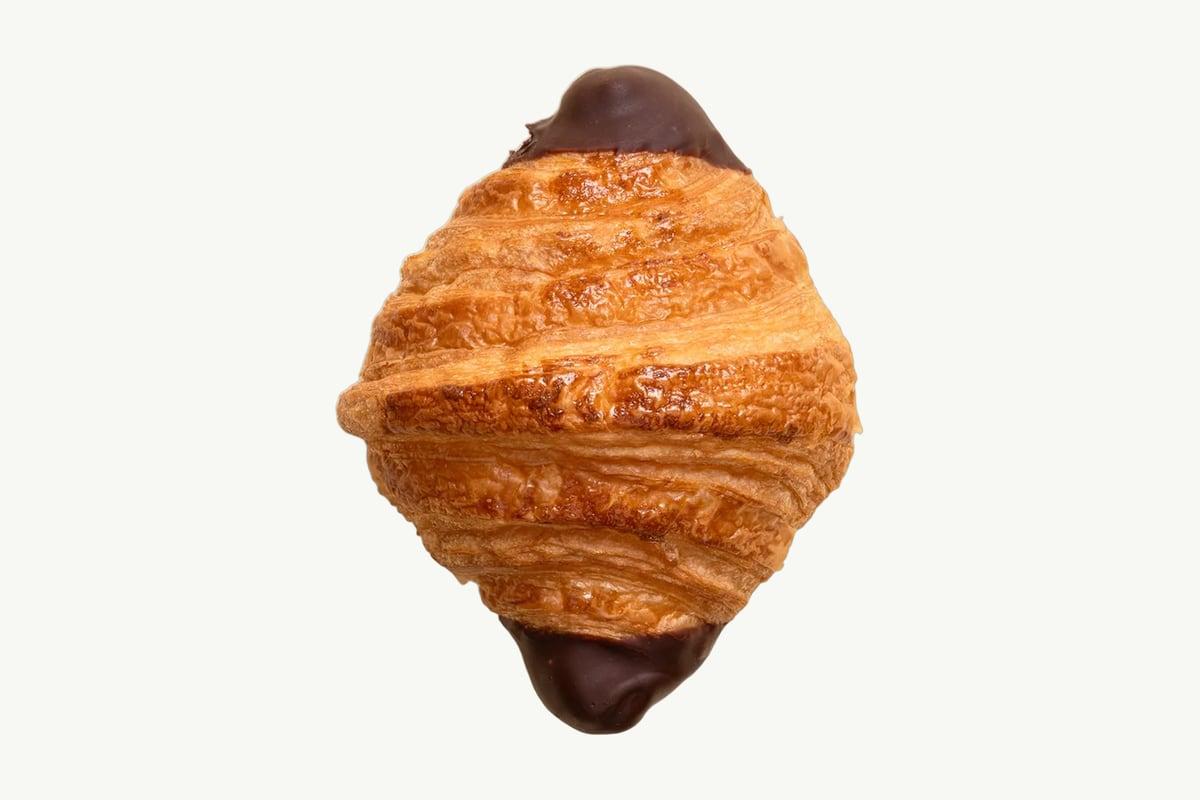
A pain au chocolat is not a croissant with chocolate added. It is built from a rectangle rather than a triangle, rolled straight rather than coiled, and it carries two batons of a chocolate made specifically to survive a hot oven. Chocolate chips fail in laminated dough, and why they fail explains most of what is difficult about this pastry in a Dubai kitchen. It is also why the chocolate croissant we bake in Dubai takes a different route and wears its chocolate on the outside.
Why chocolate chips do not survive laminated dough
Cocoa butter is fully liquid around 34 to 36°C. A croissant oven runs at 200°C. So the chocolate inside any laminated pastry is molten long before the crumb sets, and the only real question is what it does while it is liquid.
Chips are engineered for cookie dough. They hold a rounded shape in a thick batter and are balanced for how they melt in the mouth, not in an oven. Put them inside laminated dough and two things go wrong. The hard point of the chip punctures the butter sheet as the dough is rolled, welding the layers at that spot. Then the fat leaving the melting chip migrates into whatever dough it touches, greasing the sheets so steam can no longer prise them apart. The result is a damp, dense seam through a flaky pastry, with a scorched sugar patch underneath where the chocolate found the tray.
Bakery batons, bâtons de boulanger, are made for this. They are extruded as flat sticks, roughly 8cm long and a few millimetres thick, with more cocoa solids and less free cocoa butter than an eating bar. When they melt, the mass thickens instead of running. They soften — you want that — but they stay where they were put.
Placement does the rest. One baton sits a centimetre in from the leading edge, the second about a third of the way along, so that when the rectangle is rolled each finishes with several sheets of dough beneath it and several above. Nothing touches the tray. Get the spacing wrong by two centimetres and the batons meet in the middle, fuse into one heavy bar, and drag the centre of the pastry down as it proves.
How the shape changes the way it eats
The dough is the same as for a plain Croissant at 14 AED (how lamination makes or breaks it): a lean yeasted détrempe of about 11 to 12 per cent protein flour, wrapped around European-style butter at roughly 82 per cent fat, then given three letter folds for twenty-seven butter layers.
What changes is the geometry. A croissant is cut as a triangle, stretched, then coiled, so the layers spiral outward and the tips bake dry while the middle stays soft. A pain au chocolat is cut as a plain rectangle, about 8cm by 15cm, and rolled straight into a squat block. The layers stack roughly vertically instead of spiralling, and the roll is denser because there is no taper to lighten the finish. That is why a good one eats chewier than a croissant, with a defined crust top and bottom rather than shattering shell all round. It is also why it bakes seam-side down: the weight of the pastry seals its own join during proving, and one baked seam-up unrolls in the oven.
Butter temperature is the whole game here
Lamination wants dough and butter at the same firmness, and that window sits at roughly 14 to 16°C. Warmer and the butter turns greasy and absorbs into the dough. Colder and it fractures into shards that puncture the sheets. In Dubai a working kitchen can sit above 30°C before the ovens are lit.
So the work is timed to the fridge rather than the clock. Dough returns to cold between every fold, thirty to forty-five minutes at 4°C. Sheeting is done in short passes, because friction warms dough faster than most people expect. Shaped pastries are retarded overnight, twelve to sixteen hours at 4°C, which builds flavour while the butter stays set. They prove at 24 to 26°C and never warmer; above about 28°C the butter leaks out before the oven can turn its water into steam, and you get a flat pastry in a pool of fat. We bake near 200°C, then drop to 180°C. Deep amber, not pale gold.
Why our chocolate croissant wears its chocolate outside
Our Chocolate Croissant at 16 AED takes the opposite approach. The croissant is laminated, proved and baked on its own, then dipped once it has cooled completely.
That solves the moisture problem. Enclosed chocolate releases a little steam into the surrounding dough as it melts, which is fine on the day and less fine on hour six. A dipped shell never wets the layers at all, so the shatter underneath lasts longer, and the chocolate is tasted as chocolate rather than as a warm smear.
Tempering is the fussy part. Cocoa butter sets into several crystal forms, and only one, the form chocolatiers call V, gives gloss, a clean snap and a stable surface. Dark couverture is worked down and brought back to around 31 to 32°C for dipping. Let it sit warm and reset badly, and unstable fat crystals migrate to the surface as pale streaks. That is fat bloom, and Dubai produces it easily — a dipped pastry left in a car for twenty minutes has lost its temper.
Sugar bloom is the other risk, and the reason we ask people not to refrigerate a dipped croissant. Take a cold pastry into humid air, condensation forms on the chocolate, dissolves surface sugar, then dries to a dull grey grit. Keep it at room temperature, in paper.
Where the cookie croissant fits
The Cookie Croissant, also 16 AED, is the newer hybrid, working on a different principle again. The croissant is baked on its own first, so the layers lift freely, then topped with cookie dough and returned to a cooler oven for a second, shorter bake. We explain the reasoning in why a cookie croissant is baked twice.
That second bake has to be watched. The topping spreads and cracks into a sandy, biscuit-like lid, and its sugar colours well before the pastry beneath has finished drying. Too hot or too long and you have a dark cookie over a brittle croissant. The reward is two textures in one bite.
We bake in Dubai Silicon Oasis and deliver across Dubai, and every order is baked for the day it is due. Details are on the delivery page.
Keeping and reviving laminated pastry in Dubai
Humidity is the enemy of everything laminated. Left on a plate here, a croissant draws water from the air and goes leathery in hours. Store it in paper, never a sealed plastic box, which traps steam and softens the crust from within.
Eat it the day it is baked if you can. If not, freeze it whole in a sealed bag on the same day and reheat from frozen at 170°C for six to eight minutes. Day-old and unfrozen, four to five minutes at 160°C restores the shatter. Never use a microwave; it steams the butter layers and they collapse for good. A dipped croissant needs gentler handling, because reheating melts the shell: three minutes at 150°C, then ten undisturbed so the coating firms again.
Frequently Asked Questions
What is the difference between a pain au chocolat and a chocolate croissant?
A pain au chocolat is a rectangle of laminated dough rolled straight around two chocolate batons, so the chocolate bakes inside. A chocolate croissant, as we make it, is a crescent-shaped croissant baked first and then dipped in tempered chocolate. The pain au chocolat eats chewier, the dipped croissant keeps a crisper shell.
Why do bakers use chocolate batons instead of chocolate chips?
Batons carry more cocoa solids and less free cocoa butter, so they thicken rather than run when they melt at oven temperature. Chips are made for cookie dough. Their hard points puncture the butter layers during rolling and their fat migrates into the dough, welding the sheets together and leaving a dense, greasy seam.
How much is a chocolate croissant in Dubai at Farah Bakery?
Our Chocolate Croissant is 16 AED and the Cookie Croissant is also 16 AED. The plain Croissant is 14 AED, per pastry. All three can be ordered from our shop page for delivery across Dubai, including Dubai Silicon Oasis and the communities around it.
Why has the chocolate on my croissant turned grey?
That is bloom, and it is cosmetic rather than spoilage. Fat bloom appears as pale streaks when tempered chocolate gets warm and resets badly, which happens quickly in a hot car. Sugar bloom is a grey grit that forms when a refrigerated pastry meets humid air and condensation dissolves the surface sugar. Store at room temperature.
Can I freeze a chocolate croissant?
Yes, but freeze a plain or baton-filled one rather than a dipped one, because freezing and thawing dulls tempered chocolate. Bag it whole on the day it is baked, then bake straight from frozen at 170°C for six to eight minutes. Let it rest two minutes before eating so the trapped steam escapes and the layers set.
Order a chocolate croissant
Our Chocolate Croissant is 16 AED, baked and then dipped for the day it is due. Add a plain croissant or two to compare the crumb, and see the rest of the bake on the shop page. There is no same-day delivery: the earliest delivery window is the next morning, and you choose your window at checkout.