5 August 2026
Soft Pretzel Dubai: Why the Lye Bath Changes Everything
A real pretzel is defined by one step most bakeries skip — the alkaline bath that builds its mahogany crust and dense chew.
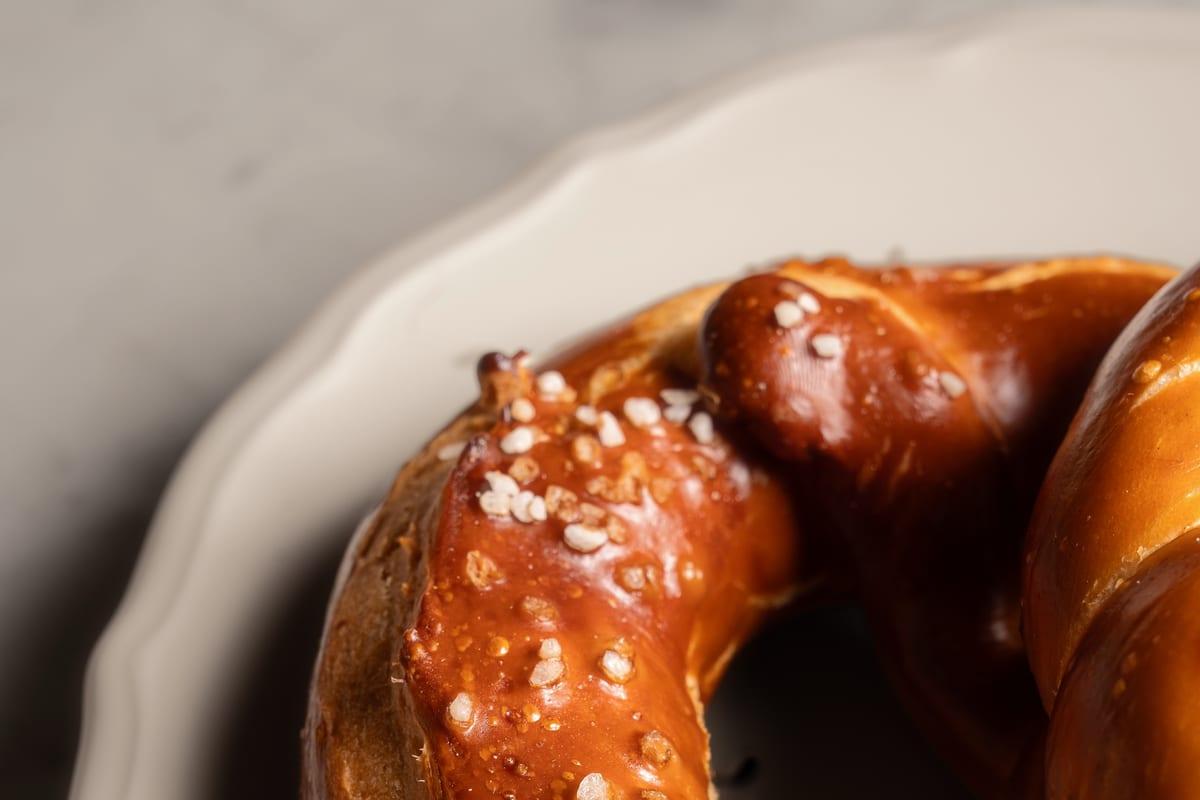
A real soft pretzel is defined by one step most bakeries skip: a short dip in an alkaline bath before it goes into the oven. That bath is what produces the mahogany shell, the faint mineral tang and the dense, elastic chew that separates a pretzel from everything else on a bakery counter. Without it, you are eating a bread roll tied in a knot.
We bake our soft pretzel the German way in Dubai Silicon Oasis, and this is what goes into it.
What the alkaline bath actually does
Browning in bread is the Maillard reaction — amino acids and reducing sugars rearranging themselves under heat. That reaction runs faster as pH rises. A shaped pretzel dipped for ten to twenty seconds in a cold food-grade alkaline solution comes out with a surface sitting well above pH 12, so it browns dramatically at a temperature where an ordinary roll would still be pale.
The bath does three things at once. It gelatinises the outer layer of starch, which is why the finished crust looks lacquered rather than floury. It seals that surface, so steam driven out of the crumb during baking is partly trapped, giving the interior its close, slightly moist, chewy structure instead of an open airy one. And it leaves behind the distinctive savoury tang that people recognise as "pretzel" before they can name it.
This is bakery work, not home work. Food-grade sodium hydroxide is caustic in solution and handled with gloves and eye protection in a dedicated tub. It is not dangerous in the finished product: during the bake it reacts with carbon dioxide and the dough itself and ends up as harmless sodium carbonate. If you want to try the effect at home, bake plain bicarbonate of soda on a tray at 150°C for an hour to convert it to sodium carbonate, then dissolve it in water for a much gentler dip. You will get some of the colour. You will not get all of the chew.
A bagel is the nearest cousin: it is boiled too, but in plain malted water, which sets a glossy skin without the deep colour or the tang. Our guide to how the boil and a cold night make a bagel covers that side of the family.
Why a pretzel is not a bread roll in a knot
The dough is the other half of the answer, and it goes against most bread instincts.
Pretzel dough is stiff. We work at roughly 50 to 55 per cent hydration, against 75 per cent or more for a country sourdough. It uses strong wheat flour at around 12 per cent protein, a little butter or oil for tenderness, a touch of malt for colour, and no attempt whatsoever at an open crumb. The mixer has to work it hard to develop gluten in a dough that dry.
Shaping matters more than in almost any other bread. The rope is rolled long, thick in the middle and tapering to thin arms, then crossed twice and pressed down. The thick belly and thin arms are not decoration: the arms bake crisp and snappy while the belly stays soft and chewy, so a single pretzel gives you two textures. After shaping, the pretzels rest uncovered and cold. Drying the surface is deliberate — a skinned, chilled pretzel takes the bath cleanly and holds its shape instead of slumping.
They bake hot and fast, around 200 to 215°C for fourteen to eighteen minutes, with the belly slashed just before loading so it opens into that pale seam across the dark crust. Coarse salt goes on wet from the bath, which is the only reliable way to make it stick.
Start with the plain pretzel
The Authentic Soft Pretzel at 8 AED is the reference point — bare crust, coarse salt, nothing hiding the bake. If you have never had a lye-bathed pretzel, this is the one that shows you what the bath does, because there is nothing on top to distract from the crust.
Adding cheese or vegetables at home
Cheese and vegetable pretzels are not currently available to order online, but they are what home bakers ask about most, and both come down to what the bath has done to the surface.
Cheese goes on after the bath, never before. The pretzel comes out of the dip wet with alkaline solution, and alkali attacks casein directly: cheese held in it turns slippery, faintly bitter and will not brown cleanly, and the fat and dairy solids it sheds foul the bath for the next batch. Once the cheese is on, the raised surface pH speeds its browning as well as the crust's, and it colours from underneath where you cannot see it, so bake to the cheese rather than to the arms. Firm, medium-aged, low-moisture cheeses such as mature cheddar melt into an even sheet. Fresh mozzarella weeps water and then oil, and pre-shredded cheese coated in anti-caking starch browns without ever flowing together. Mind the salt too: a strongly salted cheese on a salted crust tips from savoury to punishing.
Vegetables are the harder problem, because they release water rather than fat, and a wet alkaline crust will not crisp. Peppers and onions give up their water gradually, and onions caramelise well on an alkaline surface. Tomatoes, courgette and mushrooms collapse and flood the crust if they go on raw, so cook them down in a pan first. A thin layer of cheese over the top helps by sealing some of that moisture in. Either way, a topped pretzel softens sooner than a plain one, so plan to eat it soon after it leaves the oven.
How to keep a pretzel good in Dubai's humidity
A pretzel is at its peak for about four hours. That is not a marketing line, it is physics: the salt and the alkaline crust are both hygroscopic, and Dubai air in August will move moisture into that crust faster than almost anywhere else. Once the shell goes soft it does not come back on its own.
Three practical rules. Keep them in paper, never plastic, for same-day eating — plastic traps the steam still leaving the crumb and turns the crust leathery within an hour. Do not refrigerate them; the fridge is the fastest possible environment for starch retrogradation and a pretzel goes stale there in a day. If you are not eating them the same day, freeze them the day they arrive in a sealed bag with the air pressed out. Our guide to storing bread in Dubai applies the same logic loaf by loaf.
To revive: straight from the freezer into a 160°C oven for six to eight minutes, no thawing, no foil. A day-old pretzel that has gone soft responds to three minutes at 180°C, which drives the moisture back out of the crust; an air fryer at 180°C does the same job in three to four minutes, so check it at three. Never use a microwave on a pretzel. It steams the shell from the inside and you lose the only thing that made it a pretzel.
What to serve with one
Split it horizontally through the belly and butter it cold — the salt and the butter do most of the work. Mustard is traditional, and pickles do the same job of cutting through the richness. Labneh with olive oil is better than it has any right to be, and the tang of the crust holds up against it.
Pretzels also make good sandwich bread if you split one and keep the filling simple. And a plain pretzel alongside karak in the late afternoon is, in our view, the correct use of both.
We bake from Dubai Silicon Oasis and deliver across Dubai. There is no same-day delivery and the earliest window is the next morning, so choose the window closest to when you will eat them — the details are on our delivery page.
Frequently Asked Questions
Is there real lye in a soft pretzel, and is it safe to eat?
Yes, traditional German pretzels are dipped in a dilute food-grade sodium hydroxide solution before baking. It is caustic in the tub and handled with protective equipment, but it does not survive the oven. During baking it reacts and converts to sodium carbonate, the same compound left behind by baked bicarbonate of soda. The finished pretzel is safe.
What is the difference between a soft pretzel and a bread roll?
Three things: the alkaline bath, the dough and the shape. The bath raises surface pH so the crust browns deep mahogany and turns glossy and slightly tangy. The dough is much drier than roll dough, around 50 to 55 per cent hydration, which gives the dense chew. And the thick-belly, thin-arm shape produces soft and crisp textures in one piece.
How long does a soft pretzel stay fresh in Dubai?
Roughly four hours at its best. Humidity moves into the salted crust quickly and softens the shell. Keep it in paper for same-day eating, never in plastic and never in the fridge, which stales bread fastest. Freeze anything you will not eat that day, then bake from frozen at 160°C for six to eight minutes.
Can I put cheese on a pretzel before the lye bath?
No. The bath is a brief dip and the pretzel comes out wet, so cheese applied first either washes away or sits in alkaline solution. Alkali breaks down casein, leaving the cheese slippery, faintly bitter and unable to brown cleanly. Add it after the bath, just before the pretzel goes into the oven.
How much does a soft pretzel cost at Farah Bakery?
The Authentic Soft Pretzel is 8 AED. It is the pretzel we currently offer online: the same stiff dough, the same alkaline bath and the same hot, fast bake every time, finished with nothing more than coarse salt, so it is the clearest way to taste what the bath does.
Order a pretzel while the crust is still crisp
Pretzels are worth catching fresh, which is the whole argument for choosing a delivery window close to when you will eat them rather than picking them up in passing. Start with the Authentic Soft Pretzel at 8 AED to taste the bath properly. The full range is in the shop.