30 August 2026
Grazing Tables and Event Catering in Dubai
A grazing table is a structural problem before it is a styling one, so this is what holds up over two hours in a warm room and what collapses in twenty minutes.
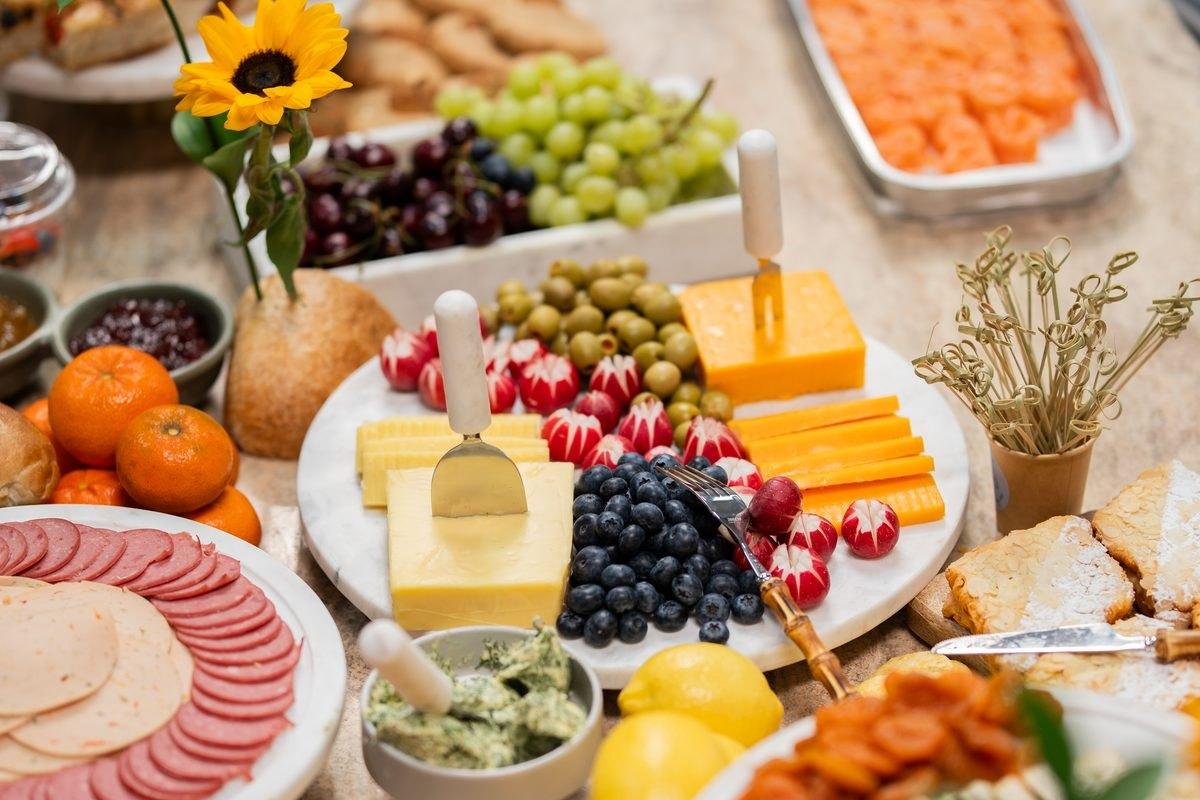
The photographs of a grazing table are always taken in the first five minutes. That is the easy part. The real test is what the table looks like ninety minutes later, after forty people have been through it, in a room that is warmer than the kitchen it was built in.
We have built a long grazing table for our own morning at Pravilo in Al Quoz and a grazing spread for Kure, and fed partner events in other formats — granola parfaits and fresh-baked treats for a lululemon morning in the Dubai Aquarium tunnel and in store, a gift bag at every mat at Arte Museum. Almost everything we have learned is about what survives, not what photographs well.
Build it in layers, not on a flat plane
A table laid out flat reads as scattered food. A table with height reads as abundance, and it uses less food to do it.
The method is simple: boards, inverted bowls, wooden crates and cake stands go down first, under the cloth or on it, so the surface has three or four distinct levels. Heavy structural items — whole cheeses, big boards, bowls of dips — anchor the high points. Everything else fills the valleys between them.
The practical benefit is that a layered table degrades gracefully. When guests take from it, the gaps appear in the low-lying filler rather than in the silhouette. A flat table develops holes that are visible from across the room within twenty minutes.
What actually survives two hours in a warm room
This is the part that gets decided by physics rather than taste.
Hard and semi-hard cheeses hold their edge through a long service. Soft ripened cheeses sweat and slump, so they go out later or in smaller quantities that get replaced. Cured meats are stable; anything cooked and sliced is not, and should be treated as a replenished item rather than a static one. Whatever the item, cheese, meat and anything with yoghurt follow standard food-safety guidance: no more than two hours out of the fridge in total, or one hour above 32°C, so bring them out in small batches from a fridge or cool box and throw away anything that has sat out past that limit.
Whole fruit and firm cut fruit — grapes, berries, citrus segments, apricots — hold well. Anything with a large cut face and high water content browns and weeps. Blueberries and grapes will look the same at the end as at the start, which is why they end up doing so much visual work on a table like this.
Bread is the item people get wrong most often. A crusty Sourdough Baguette at 15 AED is superb for the first hour and then noticeably tired, because a high crust-to-crumb ratio means fast moisture loss; a baguette really has one good day. A Sourdough Ciabatta at 14 AED, with a thinner crust and a crumb that holds its moisture, lasts a little longer on the table and still toasts well the next morning. Put both out in batches rather than all at once.
Focaccia is the opposite and is the single most useful bread on a grazing table. Olive oil worked through the crumb interferes with staling, so a Focaccia · Rosemary & Olive Oil at 12 AED is still soft and good at the end of a two-hour service. Cut into fingers, it also holds its shape in a way a torn baguette does not.
Wet things need a barrier
Dips, dressings, roasted vegetables and anything oily will migrate. Left in direct contact with bread or crackers they produce a soggy ring within half an hour, and it spreads.
The fix is separation with intent rather than distance. Wet items go in bowls with a visible edge, and the bowls sit on their own board or a layer of leaves rather than directly among the dry items. Where a bread has to sit near something wet, choose one with an open crumb — a ciabatta or focaccia holds oil in pockets between thick cell walls instead of wicking it through, which is exactly why those breads carry dressed fillings so well, as our guide to sandwich breads explains.
Serve with dedicated tools per bowl. It sounds fussy; it is the difference between a table that holds together and one where every board has been cross-contaminated by the second wave of guests.
Sweet, and when to put it out
Sweet items on a grazing table have a timing problem: they compete with the savoury side if put out at the start, and they are forgotten if put out too late.
The practical answer is a separate zone at one end of the table from the beginning, and a top-up midway through. Cookies hold better than anything else — they are low-moisture by construction and they look the same after two hours. Cakes cut into fingers hold well; anything with an unstable cream or a glaze that softens does not.
For a morning event, parfaits in individual cups solve several problems at once. They are portioned, they are portable, they do not degrade the table around them, and guests can take one and walk away, which matters when the room is moving. Keep them in the fridge until about five minutes before guests reach them. For lululemon, granola parfaits were tagged and set at every place and more went out on the counter of their store, while each mat in the Aquarium tunnel had a Farah Bakery bag beside it. Our wellness event catering guide covers feeding people around a class.
Quantities, and the mistake everyone makes
The common error is ordering by headcount as though everyone eats a full meal. On a grazing table people graze — they take small amounts many times, and the total consumed per head is lower than a plated equivalent while the visual quantity needed on the table is much higher.
So the two numbers move in opposite directions. You need more surface coverage than you think and less total food than a sit-down. Under-covering the table is far more noticeable than running slightly short, which is why the structural layering matters: it buys coverage without buying volume.
Plan replenishment from the start. Keep roughly a fifth of everything back in the fridge or a cool box, in the same containers, and refill the low-lying areas rather than rebuilding. A table topped up twice looks better at the end than a table that was maximal at the beginning.
Ordering for an event
Everything we bake is baked to order, which means an event order needs to reach us far enough ahead to be planned into a bake. Sourdough in particular goes through hours of bulk fermentation, then shaping and an overnight cold retard before it is baked, so it cannot be turned around on the day. Even for an everyday order from our shop, the earliest delivery window is the next morning, so the more notice you give us for an event, the better.
For a single event, tell us the headcount, the room, the duration and whether it is morning or evening — those four things determine the bread far more than the menu does. Send those details through the Bring Farah to your event form and we reply within one working day. Our past events are on the same page. For general questions or regular supply, get in touch; the range we bake for businesses is on the wholesale page; our guide to choosing a wholesale bakery supplier lists what to ask.
Frequently Asked Questions
How do I stop a grazing table looking picked-over halfway through?
Build it in layers using boards, crates and inverted bowls so the table has height, and anchor the high points with heavy items. Guests then take from the low-lying filler and the silhouette survives. Hold back around a fifth of everything to refill the gaps.
Which bread works best on a grazing table?
Focaccia, because the olive oil through its crumb slows staling and it is still soft two hours in. A crusty baguette is excellent for the first hour but loses moisture quickly, while ciabatta holds a little longer, so put crusty breads out in batches rather than all at the start.
How do I keep dips from making the bread soggy?
Put wet items in bowls with a visible edge, sitting on their own board rather than among the dry items, with a dedicated tool per bowl. Where bread must sit near something wet, use an open-crumbed bread that holds oil in pockets instead of wicking it through.
How much food do I need per person for a grazing table?
Less total food than a plated meal but far more surface coverage. People take small amounts repeatedly rather than one full portion, so the risk is an under-covered table rather than running out. Layering for height gives you coverage without buying extra volume.
How far in advance should I order catering from a bakery?
As early as you can, and never on the day. Everything is baked to order, and sourdough needs hours of bulk fermentation, then shaping and an overnight cold retard, before it is baked. Giving a bakery the headcount, room, duration and time of day early lets it schedule the bake properly.
Plan an event with us
Tell us the headcount, the room and the time of day and we will put together the bread and pastry side of it. See what we have done before on the events page, browse the full bake in the shop, and tell us about your event to start.