Seeded Sourdough in Dubai: Why the Seeds Fight the Dough
Seeds are thirsty and they cut gluten — here is how a seeded loaf is actually built, and how to keep it in Dubai.
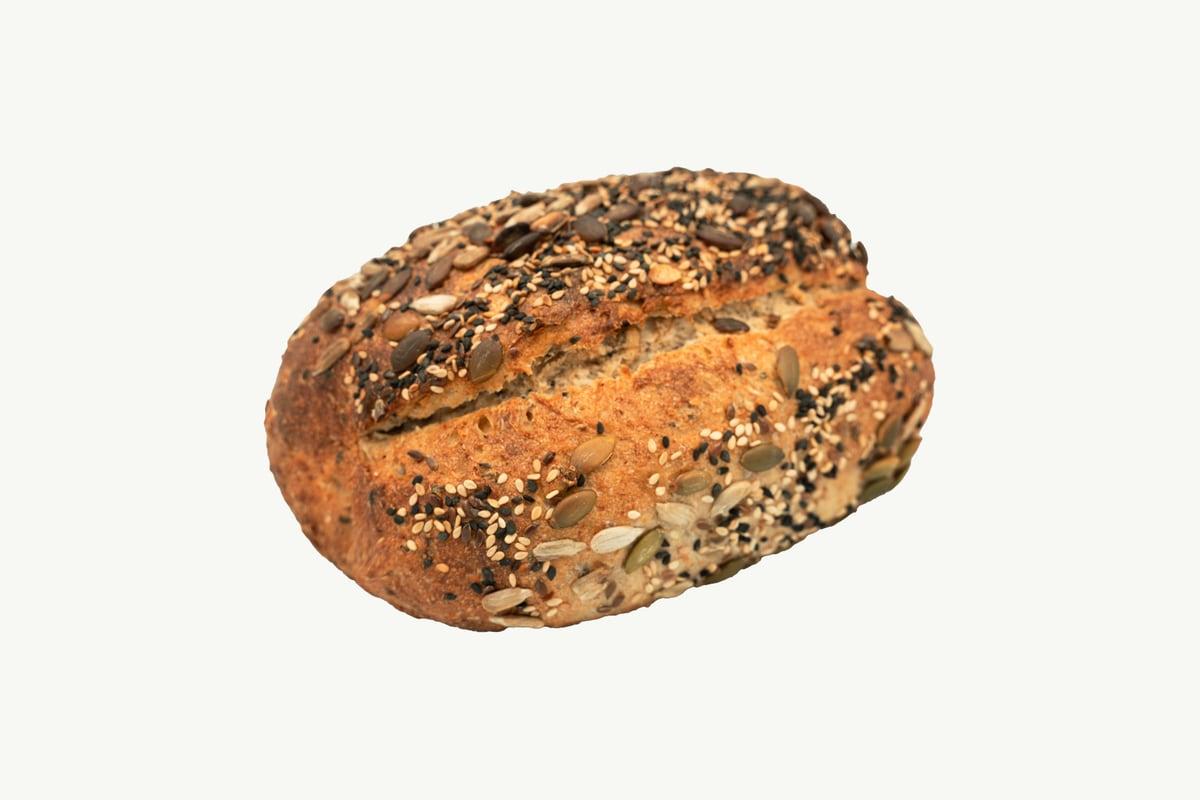
A seeded sourdough is not a plain loaf with seeds thrown at it. Seeds are thirsty, they cut gluten strands as the dough stretches, and untoasted they taste green and raw — so they are soaked or toasted before they meet the flour, and the water is raised to pay for them. Get that wrong and you bake a dry, tight brick. Get it right and you have the loaf that stays good longest on a Dubai counter.
Our Multi-Seed Sourdough Loaf (28 AED) is built around that problem. Here is what actually happens between the seeds and the dough.
Why seeds fight the dough
Three separate arguments run inside a seeded dough, and they pull in different directions.
The first is water. Sunflower, pumpkin, sesame, flax and millet all go in dry, and flax is greedy — it takes on several times its own weight in water and turns slippery with mucilage while it does. Dry seeds do not sit politely alongside the dough's water; they pull it out of the crumb during mixing, during proof, and for hours after the loaf leaves the oven. That is the classic mistake behind a seeded loaf that feels dry and crumbly on day one.
The second is structure. Gluten is a network of long, elastic strands, and the hard edges of cracked sunflower kernels and pumpkin seeds act like small blades every time the dough is stretched. A dough carrying 15 to 25 per cent of its flour weight in seeds tears where a plain dough would stretch. So the gluten is developed first, in a long autolyse and the early folds, and the seeds go in late, folded through at the last set of turns.
The third is flavour. Raw seeds taste grassy and slightly bitter, and that flavour does not cook out of the middle of a loaf. Heat is what turns them nutty, and the crumb of a bread never gets hotter than about 98°C — nowhere near enough.
Toasted, soaked, or both
The answer to all three is to prepare the seeds separately, and the method depends on the seed.
Sunflower, pumpkin and sesame get toasted — a flat tray, 160 to 170°C, eight to ten minutes, shaken once, out while still pale gold. Sesame turns bitter fast; the gap between fragrant and burnt is perhaps ninety seconds. Toasting wakes the oils, which is the taste you want, but it also leaves the seed drier and thirstier than before.
The toasted seeds are then soaked, together with the flax and millet, in roughly their own weight in cold water, for four to twelve hours. By the time that soaker goes into the dough the seeds are already full. They have taken their water from the bowl rather than from the crumb, and the flax has thrown its gel, which stays in the loaf and holds moisture there. Soaking cold matters in August: a warm soaker raises the final dough temperature by two or three degrees, and in a Dubai kitchen the dough is already running warm.
Hydration, temperature and the proof
Because the seeds arrive pre-loaded with water, the numbers on the recipe card look alarming and the dough in the hand does not. Total hydration sits well above what the same flour would take plain, but most of that extra water is locked in the soaker rather than free in the dough. What changes is the finished crumb, which stays moist for days instead of hours.
Fermentation is the usual sourdough sequence adjusted for a hot climate: a stiff levain, a dough temperature target near 25°C, a bulk of roughly four hours with gentle coil folds rather than aggressive stretching, then shaping and a cold retard overnight at 4 to 5°C. The retard does two jobs. It builds the acidity that gives sourdough its keeping quality, and it firms the dough so a seed-weakened gluten network can still hold a score.
In the oven the loaf goes in hot and covered — around 250°C with steam for twenty minutes — then uncovered and dropped to about 225°C for another twenty to twenty-five. That drop is not optional here: the seeds crusted on the outside sit in the hottest, driest air in the oven, and at a flat 250°C the sesame and sunflower will be black before the centre reads 96°C.
Why a seeded loaf keeps longer than a plain one
Bread does not go stale because it dries out. It goes stale because the gelatinised starch in the crumb slowly recrystallises, squeezing water out as it reorganises. Anything that gets in the way slows that down.
A seeded sourdough gets in the way three times over. The soaker acts as a reservoir, releasing water into the crumb over days instead of surrendering it in the first hour. The oils drawn out of the sunflower and flax by toasting coat the starch and interfere with it setting up again. And the acidity from a long fermentation slows both staling and the surface mould a humid coastal city encourages.
The practical result: a Country Sourdough Loaf (25 AED) is at its best on day one, and a seeded loaf of the same weight keeps its crumb moist for longer, is honestly good on day three, and toasts beautifully on day four.
Loaf or toast bread? They are not interchangeable
This is where most people order the wrong one.
The Multi-Seed Sourdough Loaf is a free-form loaf: thick, blistered, chewy crust, an irregular crumb, a distinctly sour and nutty flavour. It is built for tearing, for cheese, for soup, for a thick slice with butter. Its slices are not square, so the ends may not sit neatly in a toaster slot.
The Multi-Seed Whole Wheat Toast Bread (32 AED) is a pan loaf: whole wheat, soft, tight and even in the crumb, thin crust, square slices, made for sandwiches, lunchboxes and the morning toaster. The seeds do the same work — same soaker logic, same keeping benefit — but the structure is deliberately closed so fillings stay put and butter does not fall through.
The loaf is for the table. The toast bread is for the week, and our multi-seed whole wheat toast guide explains how its closed crumb is built.
Storing a seeded loaf in Dubai
Do not refrigerate it. A domestic fridge sits close to the temperature at which starch recrystallises fastest, so bread stales several times quicker in there than on the counter — and that holds even in August.
Dubai gives you two opposite problems in the same day. Outdoor humidity softens a crisp crust within the hour if the loaf sits uncovered near a door; air conditioning then dries the cut face overnight. The fix for both is the same: keep the loaf cut-side down on a board for two days, then move it into a paper bag inside a cloth or a bread box. Paper alone lets it dry; plastic alone traps steam and turns the crust to leather.
Past day three, slice the whole loaf and freeze it flat — frozen slices go straight into the toaster. To bring a whole loaf back, spritz the crust with water and give it eight minutes at 200°C. Eat it that day; a revived loaf only revives once. For soft loaves, pastries and cake, see our guide to storing bread in Dubai.
We bake in Dubai Silicon Oasis and deliver across Dubai, and every order is baked fresh for its delivery day. Pick the delivery window closest to the first meal you want it for, and let the rest of the week be toast.
Frequently Asked Questions
What seeds are in a multi-seed sourdough loaf?
The blend is built around sunflower, pumpkin, flax, sesame and millet. Sunflower and pumpkin give bite and nutty flavour once toasted, sesame adds aroma, and flax and millet do the quiet work of holding moisture in the crumb so the loaf stays soft longer.
Why is seeded sourdough denser than plain sourdough?
Seeds cut gluten strands as the dough stretches, and they take up space that would otherwise hold gas. A seeded loaf always has a tighter, more even crumb than a plain country loaf. That is the trade for flavour and keeping quality, not a fault in the bake.
How long does a seeded sourdough loaf last in Dubai?
Kept cut-side down on a board and then in paper inside a cloth, expect three good days at room temperature and a fourth that toasts well. Do not refrigerate it, as fridge temperatures stale bread faster than a counter does. Slice and freeze anything you will not finish.
Should I choose the seeded loaf or the multi-seed toast bread?
Choose the sourdough loaf for the table — thick crust, open crumb, cheese, soup and olive oil. Choose the whole wheat toast bread for daily sandwiches and the toaster, because its crumb is tight and its slices are square. Many households order one of each and use them for different meals.
Can I toast seeded sourdough without burning the seeds?
Yes, but drop your toaster a setting or two. The seeds on the crust are already toasted and carry oil, so they colour much faster than the crumb does. Under a grill, keep the slice further from the element and watch it closely. Sesame goes from fragrant to bitter in well under a minute.
Order a seeded loaf this week
The Multi-Seed Sourdough Loaf is 28 AED, baked to order, with its seeds soaked for hours before the dough is mixed. Add the Multi-Seed Whole Wheat Toast Bread at 32 AED and you have the table loaf and the week's toast in one delivery. Both are in the shop now.