Sourdough Bread Nutrition Facts: Calories, Fibre and Blood Sugar
What USDA reference values say about the calories, fibre, protein and minerals in sourdough-type bread, and what they cannot tell you about any one loaf.
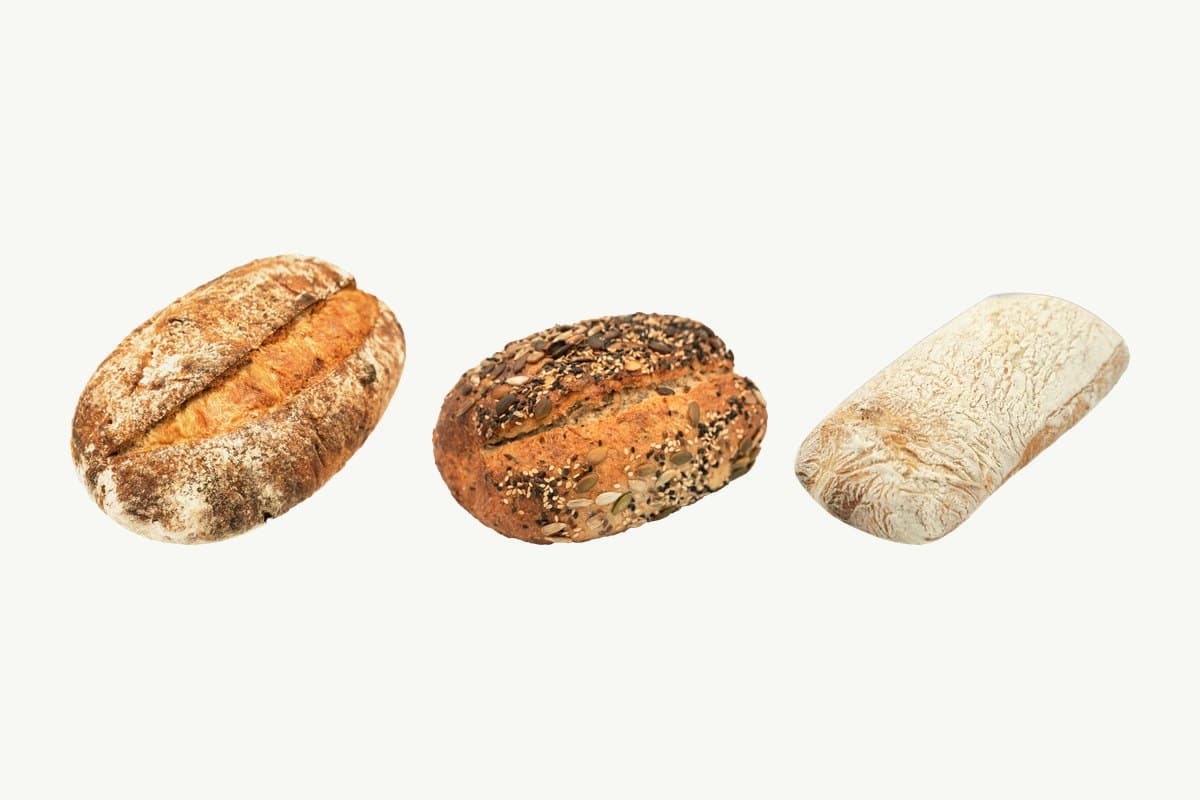
Sourdough bread nutrition facts come down to a handful of numbers. Per 100 g, the US Department of Agriculture's reference entry for French or Vienna bread, which includes sourdough, lists 272 kcal, 10.75 g of protein, 51.88 g of carbohydrate, 2.2 g of fibre and 602 mg of sodium. A medium 64 g slice works out at about 174 kcal. Weight for weight, that is not lower in calories than white bread.
These are reference values for a generic bread, not measurements of ours: we have not lab-tested our loaves and we publish no nutrition data for them. Our sourdough guide covers what the bread itself is.
Sourdough bread nutrition facts per 100 g and per slice
USDA FoodData Central has no entry for sourdough on its own. The closest is Bread, french or vienna (includes sourdough), FDC 172675, which counts sourdough in with French and Vienna bread. Unless another source is named, every figure here comes from that entry or two USDA comparison breads.
Per 100 g, the entry lists:
- Energy: 272 kcal
- Protein: 10.75 g
- Fat: 2.42 g
- Carbohydrate: 51.88 g, of which sugars 4.62 g
- Fibre: 2.2 g
- Sodium: 602 mg
- Potassium: 117 mg
- Magnesium: 32 mg
- Iron: 3.91 mg
These are USDA's unrounded values; its web pages round some figures, here protein to 10.8 g and carbohydrate to 51.9 g.
Per slice, everything depends on the slice. USDA's survey entry Bread, French or Vienna, FDC 2707610 is built entirely from the entry above, carries the same values and weighs a thin, a medium and a thick slice at 32 g, 64 g and 96 g. Scaling the per-100 g values to those weights gives:
- Thin slice, 32 g: 87 kcal, 16.6 g carbohydrate, 0.7 g fibre
- Medium slice, 64 g: 174 kcal, 6.9 g protein, 1.5 g fat, 33.2 g carbohydrate, 3.0 g sugars, 1.4 g fibre, 385 mg sodium
- Thick slice, 96 g: 261 kcal, 49.8 g carbohydrate, 2.1 g fibre
We have left out the entry's own "1 slice" portion of 139 g, which USDA does not explain.
Calories: is sourdough bread lower in calories?
Not by these numbers. Per 100 g, USDA lists 272 kcal for the French or Vienna entry that includes sourdough, 266 kcal for commercially prepared white bread and 252 kcal for commercially prepared whole-wheat bread. Sourdough-type bread sits slightly above both.
What moves the number is how much you eat. An ounce (28.35 g) of the sourdough-type bread comes to 77 kcal, the same as USDA's 29 g white slice, and USDA's 32 g whole-wheat slice comes to 81 kcal. A medium 64 g slice of the sourdough-type bread carries more than twice the calories of that white slice mainly because it weighs more than twice as much.
So is sourdough high in calories? About as high as other bread, gram for gram. If calories matter to you, weigh a slice: grams × 272 ÷ 100 gives a reference estimate, not a measurement.
Fibre: how much is in sourdough bread?
The French or Vienna entry lists total dietary fiber, as USDA spells it, at 2.2 g per 100 g, or 1.4 g in a 64 g slice. That is less than the 2.7 g in USDA's white bread and well under the 6.0 g in its whole-wheat bread, so on these values sourdough-type bread is not a high-fibre bread.
The bread with the most fibre is the one made with wholegrain flour: USDA's whole-wheat entry has almost three times the fibre of the French or Vienna one. The 2.2 g figure does not describe a sourdough made with wholegrain flour or a heavy coat of seeds, and USDA has no sourdough entry for either, so we cannot give you a number.
Protein, carbs and sugar: sourdough bread macros
Per 100 g, the French or Vienna entry has 10.75 g of protein, 51.88 g of carbohydrate and 2.42 g of fat. That is more protein than USDA's white bread (8.85 g) and less than its whole-wheat bread (12.45 g), and more carbohydrate than either (49.42 g and 42.71 g).
Sugars are 4.62 g per 100 g, against 5.67 g for white bread, and most of the carbohydrate is starch: USDA lists 44.23 g of it per 100 g. With about half its weight in carbohydrate, sourdough-type bread is not a low-carb bread.
Sodium, potassium, magnesium and iron
- Sodium: 602 mg per 100 g, higher than USDA's white (490 mg) and whole-wheat (455 mg) breads. Salt is a recipe choice, so this says nothing about any particular loaf.
- Potassium: 117 mg per 100 g, close to white bread (126 mg) and under half of whole-wheat (254 mg).
- Magnesium: 32 mg per 100 g, against 23 mg for white and 75 mg for whole-wheat.
- Iron: 3.91 mg per 100 g, against 3.61 mg for white and 2.47 mg for whole-wheat.
The iron needs a caution. The same entry lists 67 µg of folic acid per 100 g, the synthetic form added when flour is fortified, which suggests it describes bread made with US enriched flour. Its iron figure may reflect that fortification rather than anything fermentation does, and a loaf made with unfortified flour need not match it.
What fermentation changes, and what it does not
A sourdough is raised by a starter of wild yeasts and lactic acid bacteria instead of baker's yeast. The bacteria's acids give most of the flavour and make the crumb less friendly to mould, and the long ferment slows staling. How our country loaf is made follows the process from starter to oven.
The numbers cannot show what fermentation does to calories, fibre or minerals, because USDA files sourdough with other French and Vienna bread. On these reference values, sourdough-type bread is neither lower in calories nor higher in fibre than other bread. Researchers have proposed that the changes sourdough fermentation makes might alter how bread affects blood sugar, which is what the studies below tested.
Sourdough and blood sugar: what the research found
This section reports published findings. It is not advice, and we have not tested our own bread.
- A systematic review by Rolim and colleagues included 18 trials comparing sourdough with industrially made bread or a glucose solution. Blood sugar rose less after sourdough than after the comparison at one and two hours, especially with whole-wheat flour, but fasting insulin did not fall, and the authors rated the certainty of the evidence as low to very low.
- A 2026 review by Starowicz and colleagues covered 27 studies and 488 participants, mostly adults in good health plus some with pre-diabetes. Of 12 studies comparing sourdough with a yeast bread of the same flour, 10 reported some positive effect on blood sugar for sourdough, but only 2 of 26 randomised trials were judged at low risk of bias. The authors called the evidence "neither sufficient nor convincing".
- A crossover trial by Korem and colleagues gave 20 volunteers a week of industrial white bread and a week of stone-milled wholegrain sourdough. On average the breads made no significant difference to the clinical measures, but individual responses differed.
In that trial, according to the Weizmann Institute's summary, about half the participants had higher blood sugar after the white bread and half after the sourdough.
In the University of Sydney's GI database, breads labelled sourdough have measured glycaemic index values from 48, for a sourdough rye, to 82, for a half-wholemeal wheat sourdough. That spans the database's low, medium and high bands, so there is no single figure for sourdough.
In short: some studies report a somewhat smaller rise after sourdough, especially wholegrain sourdough, the reviews rate that evidence as weak, and people respond differently to the same bread. If you manage diabetes or another condition, ask your doctor or a registered dietitian how bread fits your plan.
Using these numbers when you buy our sourdough
Nothing on this page describes a Farah product. The USDA entry appears to describe US bread made with enriched flour, not bread from our Dubai Silicon Oasis kitchen.
If you use the reference values anyway, they fit a plain crusty loaf better than one with seeds, cheese, chocolate or fruit, whose extra ingredients no reference value here covers.
Our seven sourdoughs:
- Country Sourdough Loaf, 25 AED: our signature loaf, slow-fermented for over 24 hours.
- Sourdough Baguette, 15 AED, and Sourdough Ciabatta, 14 AED: both naturally fermented for over 24 hours.
- Multi-Seed Sourdough Loaf, 28 AED: coated with seeds, so the fibre caveat above applies.
- Sourdough Cheese Loaf, 28 AED: baked with cheese.
- Chocolate Sourdough Loaf, 30 AED: with chocolate pieces.
- Date, Walnut & Honey Sourdough, 30 AED: with dates, toasted walnuts and a touch of honey.
All seven loaves contain gluten. The multi-seed loaf is coated with seeds, sesame among them, the cheese loaf contains cheese and the date loaf contains walnuts. Our descriptions are not a full allergen list. Our kitchen handles wheat, gluten, eggs, dairy, nuts, peanuts, soy, sesame and seeds, so we cannot guarantee any loaf is free from traces of them. If you have an allergy, please ask us before you order.
Every loaf is baked to order for its delivery day; how our bread delivery works has the windows and fees, and our bread storage guide shows how to slice and freeze a loaf.
Frequently Asked Questions
How many calories are in a slice of sourdough bread?
It depends on the weight of the slice. Using USDA reference values for French or Vienna bread, which includes sourdough, a thin 32 g slice has about 87 kcal, a medium 64 g slice about 174 kcal and a thick 96 g slice about 261 kcal.
Is sourdough bread lower in calories than white bread?
Not by USDA's reference values. Per 100 g, the French or Vienna entry that includes sourdough lists 272 kcal, against 266 kcal for commercially prepared white bread and 252 kcal for whole-wheat bread. Per slice, it comes down to how heavy the slice is.
How much fibre is in sourdough bread?
USDA's reference entry lists 2.2 g of fibre per 100 g, or about 1.4 g in a 64 g slice, less than white bread's 2.7 g and whole-wheat bread's 6.0 g. That figure does not describe sourdough made with wholegrain flour or seeds.
Does sourdough bread raise blood sugar less than other bread?
Some studies report a somewhat smaller rise in blood sugar after sourdough, especially wholegrain sourdough, but reviews rate that evidence as weak and people respond differently to the same bread. We have not tested our bread. If you manage diabetes or another condition, ask your doctor or a registered dietitian.
Do you publish nutrition information for your sourdough loaves?
No. We have not lab-tested our loaves, so we publish no calorie, fibre or other nutrient figures for them; the numbers on this page are generic reference values. For ingredients or allergens, please contact us before you order.
Choose your sourdough, then weigh a slice
Start with the Country Sourdough Loaf at 25 AED, our signature loaf, or the Multi-Seed Sourdough Loaf at 28 AED if you like seeds. Our delivery page has the delivery details, and all seven sourdoughs are in the shop.