25 August 2026
Multi-Seed Whole Wheat Toast Bread in Dubai
Bran cuts gluten and seeds steal water. Here is how a whole wheat sandwich loaf is engineered to stay soft anyway, and how to store it in Dubai.
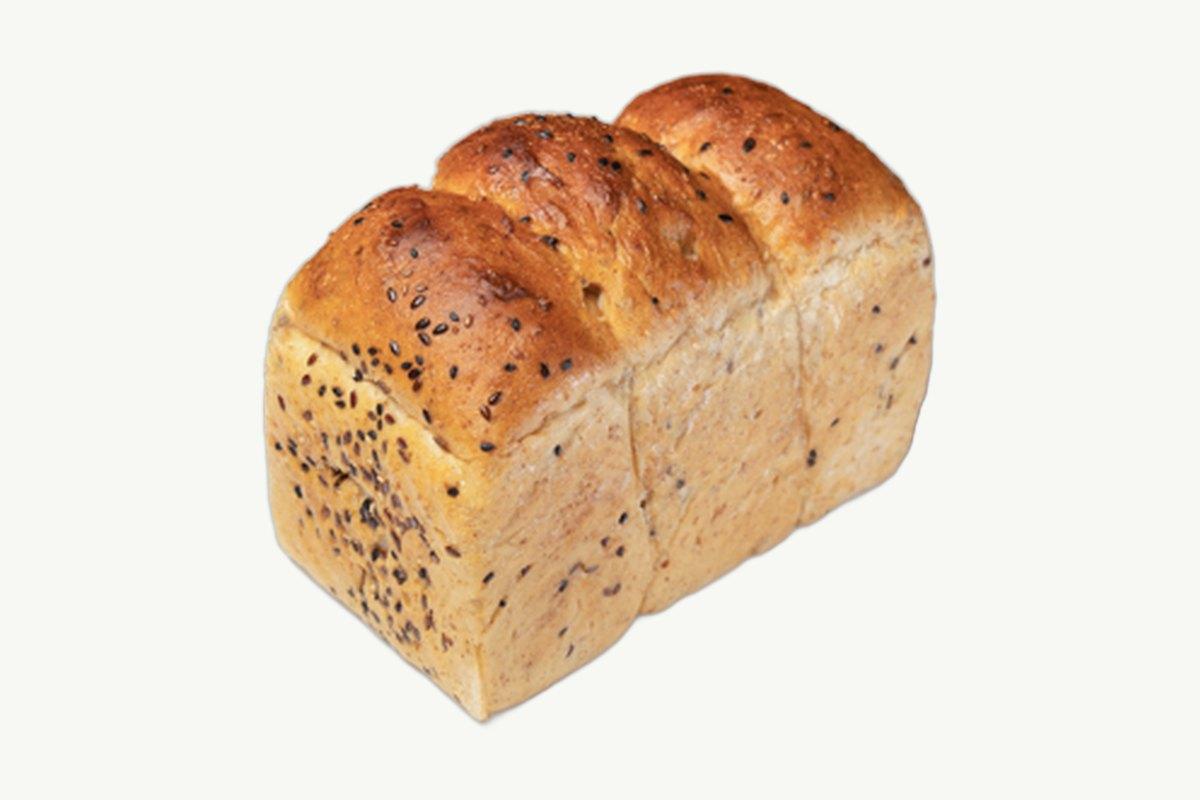
Most whole wheat sandwich bread is disappointing for the same reason: it is made like white bread with brown flour substituted in. That does not work. Bran behaves nothing like refined flour, and if you ignore the difference you end up with the dense, dry, slightly crumbly loaf that everyone remembers from childhood and nobody actually wants.
Our Multi-Seed Whole Wheat Toast Bread is 32 AED, baked in Dubai Silicon Oasis, and built around the awkward physics of bran and seeds rather than against them. Here is what actually has to change.
Bran is the problem, not the flavour
Whole wheat flour contains the bran and the germ, not just the starchy endosperm. Bran is fibrous, and under a microscope its particles have sharp edges. As dough develops, gluten forms long elastic sheets that trap the gas fermentation produces. Bran particles physically cut through those sheets.
The consequence is measurable: a dough made with 100% whole wheat holds noticeably less gas than the same recipe in white flour, and the loaf rises lower and sets denser. This is not a fault in the flour. It is a structural trade-off, and it has to be paid for somewhere.
Bran is also thirsty. It absorbs several times its own weight in water, and it does so slowly — over twenty or thirty minutes rather than instantly. A baker who mixes whole wheat dough to the same consistency as white dough and shapes it straight away is working with dough that is still drying out in the bowl. By the time it reaches the oven, the bran has pulled water out of the crumb, and the loaf bakes dry.
More water, and a rest before anything else happens
The first correction is hydration. Our whole wheat dough carries substantially more water than the equivalent white loaf, which feels wrong in the hand at first — slacker, stickier, less willing to hold shape.
The second correction matters more: the flour and water are mixed and then left alone before salt, starter or fat go anywhere near them. That rest gives the bran time to drink to capacity and soften. Softened bran has blunter edges and does far less damage to the gluten network. It also means the water is already committed, so it will not be stolen from the crumb during proofing.
That single pause is the difference between a whole wheat loaf that stays soft for two days and one that is dry the morning after baking.
The seeds have to be soaked too
Seeds present exactly the same problem, only worse. Dry sunflower, flax and sesame seeds dropped into dough act as tiny sponges. They pull water out of the surrounding crumb during proofing and again during the bake, and they bake up hard enough to be unpleasant against the teeth.
So the seeds are soaked before they go in. Hydrated seeds are already full, so they take nothing from the dough. They stay tender rather than turning into gravel, and the flax in particular releases a slippery gel that behaves a little like an extra binder, helping the weakened gluten hold gas.
Some of the seeds go through the dough and some go on the crust, where the oven's dry heat toasts them. That is where most of the aroma comes from — the nutty smell of a good seeded loaf is toasted seed oil on the surface, not the flour.
Why it is a toast bread, not a free-standing loaf
This dough is baked in a tin with a lid rather than free on a stone, and that is deliberate. A tin supports the sides of a dough that cannot fully support itself, so the loaf rises upward instead of spreading outward. The result is the square section that makes an even sandwich and fits a toaster.
Baking enclosed also keeps the crust thin and soft. A thick crust would be the wrong answer for a loaf whose job is to be sliced twice a day for a week. Compare it with our Country Sourdough Loaf at 25 AED, which is baked open specifically so it develops a hard, blistered shell — a completely different brief. The Multi-Seed Sourdough Loaf is not the same bread either: it is a free-form sourdough like the country loaf, with a thick crust, a chewier crumb and a sourdough tang, and our multi-seed sourdough guide explains how it is built.
It is a plainer, nuttier loaf than a milk bread. If you want the opposite end of the soft-loaf spectrum, our Japanese Milk Bread Loaf at 18 AED is enriched and faintly sweet, with tangzhong keeping its crumb soft, and our White Toast Bread sits between the two; our white toast bread guide explains what a soft white loaf is built to do.
How it behaves under a toaster
Whole wheat toasts faster than white. There is more residual sugar from the bran and germ, so the Maillard reaction and surface caramelisation start earlier. If you use the same toaster setting you use for white bread, you will burn it.
Drop the setting by a notch. You are aiming for the point where the surface seeds darken and start to smell nutty, which happens well before the crumb itself dries out. Butter goes on while the slice is still hot enough to melt it into the open structure rather than sitting on top.
For sandwiches it is worth toasting one side only. The toasted face goes inside, against anything wet, and acts as a moisture barrier. It is the same principle that makes our sandwiches hold up through a working day.
Storing it in Dubai
Two rules, and the second one is the one people get wrong.
Keep the loaf in a bag at room temperature, sealed. Dubai's indoor air is dried hard by air conditioning, and an unwrapped loaf on a counter loses moisture through the cut face within hours. Paper is right for a crusty bread that you want to stay crisp; a sealed bag is right for a soft toast loaf that you want to stay soft.
Do not refrigerate it. The fridge sits almost exactly in the temperature band where starch retrogrades fastest, and bread genuinely stales several times quicker at 4°C than it does at room temperature. If you will not finish the loaf within three days, slice it and freeze it in a sealed bag. Frozen slices go straight into the toaster without thawing, and they come out closer to fresh than three-day-old bread ever will.
We bake through the morning and deliver across Dubai from Dubai Silicon Oasis. Details are on our delivery page.
Frequently Asked Questions
Why is whole wheat bread usually drier than white bread?
Because bran absorbs a great deal of water and its particles cut through the gluten network that holds gas in. Unless the recipe adds more water and rests the flour before mixing, the bran pulls moisture out of the crumb and the finished loaf bakes dense and dry.
Are the seeds in the loaf soaked before baking?
Yes. Dry seeds behave like sponges in dough and steal water from the crumb during proofing and baking, and they set hard in the finished loaf. Soaking them first means they arrive already full, stay tender to bite, and leave the dough's own hydration alone.
How long does multi-seed whole wheat bread stay fresh?
Expect about three days at its best, kept sealed at room temperature rather than in the fridge, which stales bread faster than a warm counter does. Beyond that, slice the loaf and freeze it in a sealed bag, then toast the slices straight from frozen.
Should I toast whole wheat bread on the same setting as white?
No, use a lower setting. Whole wheat carries more residual sugar from the bran and germ, so it browns noticeably earlier than white bread. Take it off when the surface seeds darken and smell nutty, which happens before the crumb inside starts drying out.
What is the difference between this and a multigrain sourdough?
This is a soft, tin-baked sandwich loaf with a thin crust, built for slicing and toasting every day. A multi-seed sourdough is a free-form loaf, so it develops a hard blistered crust, a chewier crumb, and the tang that a long wild fermentation produces.
Order a loaf this week
Our Multi-Seed Whole Wheat Toast Bread is 32 AED, mixed wet, rested before shaping, and baked in a lidded tin the same morning it goes out. Browse the rest of the bread in the shop and we will bring it across Dubai.