Sourdough vs White Bread: How They Differ and Which to Buy
Starter or packet yeast, a day or a few hours: what separates a sourdough from an everyday white loaf, what that changes on the plate and in the bread bin, and what the calorie numbers do and do not say.
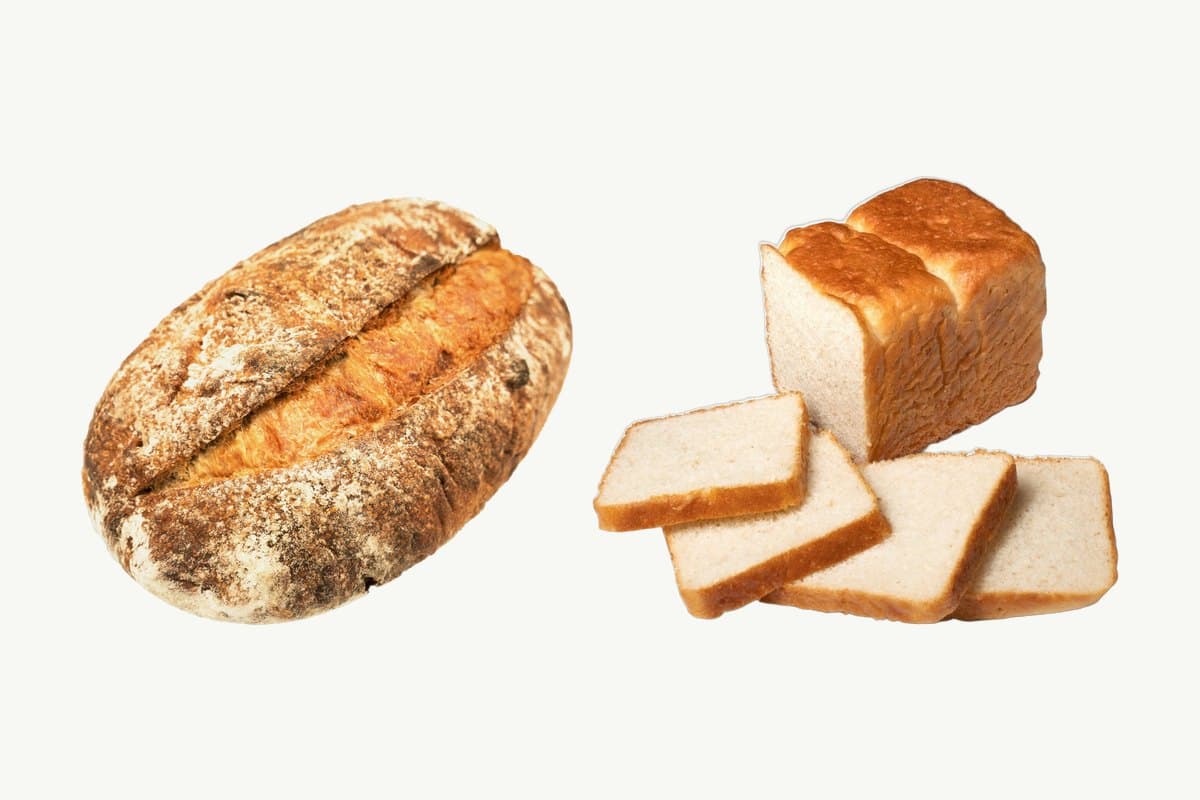
Sourdough and white bread differ mainly in how they rise and how long that takes. A sourdough is raised by a live starter of wild yeasts and lactic acid bacteria over many hours, often with a night in the cold, while an everyday white sandwich loaf is usually raised with baker's yeast in a few hours and often softened with fat, sugar or milk. That gives sourdough a crisper crust, a chewier, more open crumb, a gentle tang and slower staling, while white bread bakes soft, even and mild. By USDA reference values, sourdough-type bread is not lower in calories: 272 kcal per 100 g, against 266 kcal for white bread.
We bake both in our Dubai Silicon Oasis kitchen and deliver across Dubai: the Country Sourdough Loaf at 25 AED, slow-fermented for over 24 hours, and the White Toast Bread at 10 AED, a tin loaf with a thin, pale gold crust.
What is the difference between sourdough and white bread?
The difference is the method: sourdough rises on a live starter over many hours, while everyday white bread rises on baker's yeast in a few. Three things follow from that.
- The leavening. A starter is flour and water, fermented and fed until it holds a stable culture of wild yeasts and lactic acid bacteria. The yeasts lift the dough; the bacteria make the acids that carry most of the flavour. White bread is usually raised with a packet of baker's yeast, which works far faster.
- The time. A starter works slowly. Our Country Sourdough Loaf is slow-fermented for over 24 hours, including an overnight rest in the cold; a yeasted white loaf usually takes a few hours.
- The ingredients. Our country loaf is made from flour, water and salt, raised by the starter. A white sandwich loaf is often softened with fat, sugar or milk, which keeps the crust thin and the crumb soft.
By white bread we mean that everyday yeasted loaf for sandwiches and toast. Sourdough can be made with white flour too, so the difference is the method, not the colour of the flour. Our White Toast Bread is not sold as a sourdough.
How do sourdough and white bread taste and feel different?
Sourdough has a crisp crust, a chewy, open crumb and a gentle tang; white bread has a thin, soft crust, a fine, even crumb and a mild flavour.
- Crust. Our Country Sourdough Loaf is baked open, so it develops a hard, blistered shell, taken to a deep red-brown, with a raised ear where the score opened. The White Toast Bread is baked in a tin until the crust is thin and pale gold.
- Crumb. Inside the country loaf is an open, irregular crumb with thin, glossy walls. The white loaf has a fine, slightly springy crumb, sliced to a consistent thickness.
- Flavour. A sourdough's tang sits behind the wheat and ranges from faint to distinct; the plain country loaf is the cleanest way to taste the fermentation itself. The white loaf is milder and less sweet than our enriched loaves, so it does not compete with what you put on it.
So each suits different food: the tight white crumb browns evenly and holds butter, which is why our toast bread guide prefers a tin loaf for toast. For each loaf in depth, read why a soft white loaf is harder to bake than a crusty one and how our country sourdough is made.
Which keeps longer in Dubai, sourdough or white bread?
A large sourdough keeps longer: our Country Sourdough Loaf slices well for three to four days, while our White Toast Bread wants slicing and freezing beyond a couple of days.
Acidity helps: mould grows less readily in a more acidic crumb, and the long fermentation slows staling, while a thin, soft crust does less to hold moisture in. Size counts too, since a slim baguette is mostly crust, and crust softens quickly. Each loaf's own storage advice:
- Country Sourdough Loaf, 25 AED: cut side down on a wooden board, uncovered, for the first day, then in a cloth bag or bread tin. It slices well for three to four days; slice and freeze whatever you will not reach by day four, and toast it from frozen.
- Multi-Seed Sourdough Loaf, 28 AED: three good days at room temperature and a fourth that toasts well.
- White Toast Bread, 10 AED: in its bag at room temperature, in an air-conditioned room and away from a sunny window. Beyond a couple of days, slice it and freeze it, then toast straight from frozen rather than thawing.
- Sourdough Ciabatta, 14 AED: best on the day it arrives, and still good toast the next morning.
- Sourdough Baguette, 15 AED: in its paper bag, eaten the day it arrives.
None of them goes in the fridge, where bread stales faster than on the counter. Our guide to storing bread in Dubai covers freezing and reviving, loaf by loaf.
Is sourdough healthier than white bread?
We make no health claims for our bread, and by USDA reference values sourdough-type bread is not lower in calories than white bread.
USDA FoodData Central has no generic reference entry for sourdough on its own. We compared its closest entry, Bread, french or vienna (includes sourdough), FDC 172675, with Bread, white, commercially prepared, FDC 174924. Per 100 g, as listed when we checked on 13 October 2026:
- Energy: 272 kcal for the sourdough-type bread, 266 kcal for white bread.
- Fibre: 2.2 g against 2.7 g.
- Protein: 10.75 g against 8.85 g.
- Carbohydrate: 51.88 g against 49.42 g.
Gram for gram, sourdough-type bread is slightly higher in calories and slightly lower in fibre than white bread. These are reference values for generic bread, not lab tests of our loaves: we have not tested our bread and publish no nutrition figures for it.
In these numbers, the flour moves fibre more than the method does: USDA's whole-wheat bread entry, FDC 172688, lists 6.0 g per 100 g, and our wheat bread guide explains what whole wheat means on a label. Our sourdough bread nutrition facts set out the full table, per-slice figures and what published studies have and have not shown.
Which should you buy, sourdough or white bread?
Buy white bread for everyday toast and children's sandwiches, and sourdough for soup, cheese and a loaf on the table.
- White Toast Bread, 10 AED: everyday toast at volume, a child's sandwich, toast under eggs on a weekday and cheese toasties.
- Country Sourdough Loaf, 25 AED: the table loaf, for soup, cheese and jam, and the one to buy when bread has to last three to four days.
- Sourdough Ciabatta, 14 AED: a sandwich you are carrying somewhere; its open crumb holds oil and dressing without soaking through.
- Sourdough Baguette, 15 AED: bread for a meal, not the week.
- Japanese Milk Bread Loaf, 18 AED: soft slices that last; it is still genuinely soft on day three.
Our bread price guide explains what the step from 10 AED to 25 AED pays for. Two worked orders at today's prices:
- A side-by-side tasting: one White Toast Bread (10 AED) and one Country Sourdough Loaf (25 AED) come to 35 AED, or 55 AED with the 20 AED delivery fee.
- A household order past the free-delivery line: two Country Sourdough Loaves (50 AED), two White Toast Breads (20 AED), a Multi-Seed Sourdough Loaf (28 AED), a Japanese Milk Bread Loaf (18 AED), a Sourdough Baguette (15 AED) and a Sourdough Ciabatta (14 AED) come to 145 AED, or 165 AED delivered. A third White Toast Bread takes the bag to 155 AED with free delivery, so you pay 10 AED less and get one more loaf.
Delivery across Dubai is 20 AED below 150 AED and free from 150 AED, with no minimum order. Checkout offers four windows, each three hours long: tomorrow 7–10 am, tomorrow 3–6 pm, the day after tomorrow 7–10 am, and next Saturday 9 am–12 pm. There is no same-day delivery, and every order is baked for the day it is due. In Abu Dhabi, the earliest delivery is 2 days after ordering, between 2 pm and 8 pm, so a loaf that keeps suits a bread order to Abu Dhabi.
All of these loaves contain gluten. The Multi-Seed Sourdough Loaf carries seeds through the dough and on the crust, sesame among them, and the Japanese Milk Bread Loaf contains dairy and egg; our product descriptions are not full ingredient lists. Our kitchen handles wheat, gluten, eggs, dairy, nuts, peanuts, soy, sesame and seeds, and we cannot guarantee that any item is free from traces of these. If anyone has an allergy or intolerance, tell us before you order and we will tell you honestly whether we can serve them safely.
How can you tell real sourdough from "sourdough-style" bread?
Ask the bakery how long its dough ferments: real sourdough takes many hours, so a bakery that makes it can tell you.
A "sourdough-style" label, or a cheap loaf that stays soft in its sealed bag for a week, is a reason to ask; our guide to spotting real sourdough goes through each check, from the starter to the price. Of our seven sourdough loaves, four ferment for over 24 hours: the country loaf, the date loaf, the baguette and the ciabatta.
Frequently Asked Questions
Is sourdough a type of white bread?
Not in the everyday sense. White bread usually means a soft yeasted sandwich loaf, while sourdough is defined by its method: a live starter and a long fermentation. A sourdough can be made with white flour, so the difference is the method, not the colour of the flour.
Does sourdough bread contain yeast?
Yes. Wild yeasts living in the starter lift the dough, alongside lactic acid bacteria that make most of the flavour. What it does without is a packet of baker's yeast, and because the starter works slowly, the dough takes many hours instead of a few.
Is sourdough lower in calories than white bread?
No, not by USDA reference values. Gram for gram it is slightly higher: 272 kcal per 100 g for the French or Vienna bread entry that includes sourdough, against 266 kcal for commercially prepared white bread. These are reference values for generic bread, not lab tests of our loaves.
Which lasts longer, sourdough or white bread?
A large sourdough usually does. Our Country Sourdough Loaf slices well for three to four days, while our White Toast Bread wants slicing and freezing beyond a couple of days. A slim sourdough baguette, though, is best eaten the day it arrives. Keep all of them out of the fridge.
Which is better for toast, sourdough or white bread?
For even, everyday toast, white bread: its fine, tight crumb browns evenly and holds butter, while an open sourdough crumb can scorch around its holes and let butter run through. Sourdough still toasts well as it firms; our Sourdough Ciabatta makes good toast the morning after it arrives.
Order sourdough and white bread from Farah
Try them side by side: a Country Sourdough Loaf at 25 AED for the table and a White Toast Bread at 10 AED for the week's toast. All seven sourdoughs are in the sourdough collection and everything else is in the shop. Order by the day before and choose your window at checkout; our delivery page covers receiving the order.